Get Full Government Meeting Transcripts, Videos, & Alerts Forever!
Get email alerts on the Historic Sites Preservation topic
No spam. Unsubscribe anytime.
Tempe commission hears staff update on Loma Del Rio, Hayden Butte and Double Butte Cemetery study
Summary
Parks staff told the Historic Preservation Commission about trail deterioration at Loma Del Rio, plans for a Mill Avenue trailhead for Hayden Butte, and a Double Butte Cemetery study that found more than 4,800 markers — 1,038 needing repair and 217 flagged as high priority; staff said draft studies and funding details will be shared with the commission.
Alex Cortese, parks manager for maintenance and operations, briefed the Tempe Historic Preservation Commission on restoration and visitor‑access work planned for three city sites and asked for input on tribal consultation and interpretive signage.
Cortese said Loma Del Rio — on the southwest portion of the Papago Preserve — was stabilized in 1994 but now has a trailhead and interpretive signage in poor condition and a trail “in very poor condition” that lacks pedestrian comfort features. He said the city is under contract to bring on a trail assessment consultant and intends to include tribal engagement and the Desert Conservation Commission in the design process for signage and a Ramada shade structure.
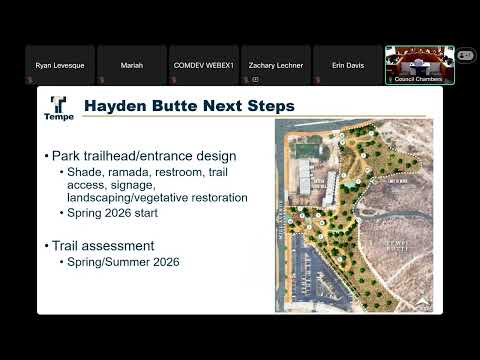
Hayden Butte, Cortese said, is listed in the National Register of Historic Places and is monitored for erosion and rock movement; the 2025 preserve management plan will guide priorities. Cortese described plans to pursue a Mill Avenue trailhead connection, a full trail assessment this year, erosion control, vegetation restoration, and options to preserve petroglyphs. “We are currently working with a trail contractor… to perform an assessment and a plan for trail improvements to address erosion,” he said.
On the Double Butte Cemetery study, Cortese said Aztec Engineering surveyed the 40‑acre site and the pioneer/historic section: “There were 4,853 grave markers surveyed. Of the over 4,000, 1,038 of them are in need of repair and 217 markers are a high priority and needing attention. They’re posing safety concerns and possible collapse.” He described recommended phased approaches covering drainage, irrigation, tree health, roadway improvements and accessibility; he noted Aztec did not include construction estimating in its scope and that cost figures in the draft study are preliminary.
Cortese said funding currently available totals about $2.8 million across several accounts, including $900,000 explicitly for historic preservation elements, $900,000 for general capital improvements, and up to $1,000,000 in matching donor funds. He told commissioners the city does not yet have a full, line‑item estimate for the preservation treatments of markers and plot enclosures and committed to provide the commission access to draft studies and follow‑up clarifications.
Commissioners pressed staff on signage content and tribal consultation. Commissioner Lerner asked whether interpretive signage would contain enough cultural context to protect sites and whether tribes might prefer limited archaeological detail to discourage disturbance; Cortese said staff will coordinate with tribes and that signage options could range from flora/fauna panels to fuller interpretive content depending on tribal preferences. Cortese added that staff would provide the commission with access to draft studies for Loma Del Rio, Hayden Butte and Double Butte Cemetery when available.
The presentation closed with multiple commissioners urging timely work on cemetery stabilization and interpretive materials and asking staff to circulate draft documents and additional cost details. Cortese and staff agreed to return with follow‑up information.
The commission did not take formal action on these studies during the meeting; Cortese said many of Aztec’s recommendations are options for the city to consider and would be evaluated for phasing and prioritization.