Lifetime Citizen Portal Access — AI Briefings, Alerts & Unlimited Follows
OCII commits to gap funding and approves predevelopment loans for Mission Bay Block 4 East
Loading...
Summary
The Commission on Community Investment and Infrastructure approved a commitment of approximately $89.6 million in residential gap funding for Mission Bay Block 4 East and authorized two $5 million predevelopment loans for phases 1 and 2 to advance design and financing; votes were 3–0 with two members absent.
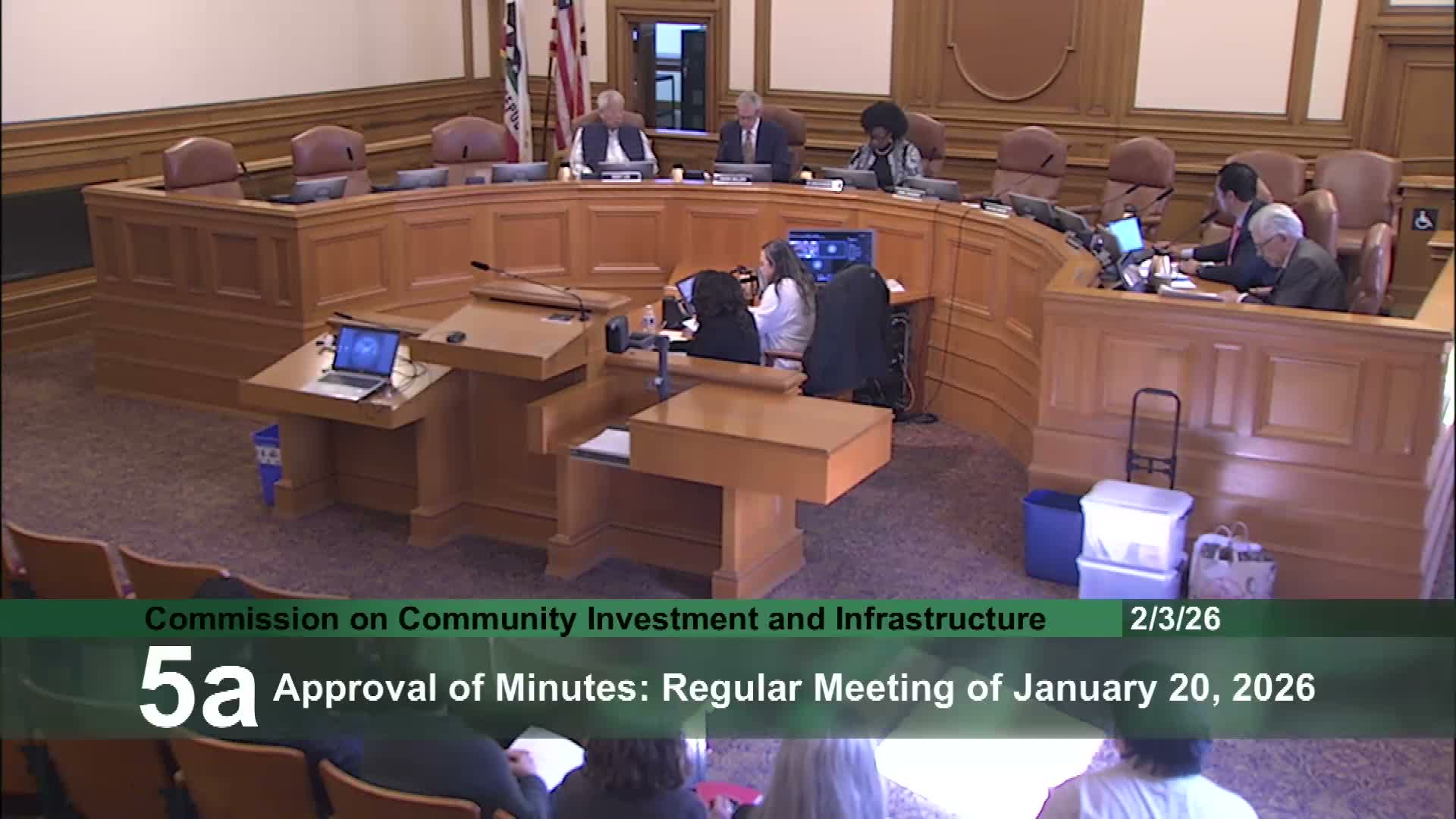
The Commission on Community Investment and Infrastructure on Feb. 3 approved a commitment of approximately $89,600,000 in OCII residential gap funding for Mission Bay Block 4 East and authorized two $5,000,000 predevelopment loans to advance Phase 1 and Phase 2.
The actions — recorded separately for each item — passed on unanimous recorded votes by attending members, with Commissioners Hakimi and Shattuck absent. Vice Chair Miller moved the primary motions and Commissioner Lim seconded.
The funding commitment is intended to strengthen developer applications for state financing programs. Philip Wong of OCII’s housing division told commissioners the commitment would be included in developers’ application packages but is not an authorization to disburse funds. "The commitment is not an authorization to enter into a loan agreement for this amount and spend it down," Wong said.
Wong described Phase 1 as a 165‑unit affordable rental project and Phase 2 as a 233‑unit affordable rental project at Mission Bay South Block 4 East. He estimated Phase 1’s total residential cost at about $188,500,000 and said the proposed financing package mixes federal low‑income housing tax credits paired with tax‑exempt bonds (CDLAC), state tax credits, a CalHFA mixed‑income program (MIP) loan, and an Affordable Housing Program (AHP) grant from the Federal Home Loan Bank. Wong cited Senate Bill 593 — enacted Oct. 23 and effective Jan. 1, 2024 — as authorizing OCII to use a limited form of tax increment to help fund replacement housing in former redevelopment project areas.
OCII’s requested $89.6 million is a "gap" commitment intended to cover the difference between total project costs and awards from other financing sources. Developers also asked OCII to provide bridge loan support equal to anticipated AHP awards so projects remain funded during construction; if AHP awards do not materialize, the bridge would be incorporated into the permanent gap loan, Wong said.
Wong said the original predevelopment loan (authorized in Sept. 2024) is being split into two loans so each phase will carry its own predevelopment financing; each predevelopment loan totals $5,000,000, inclusive of previously expended amounts. The loan agreements have a Sept. 3, 2029 maturity date with an option for the executive director to extend up to nine months to accommodate additional CDLAC rounds if needed. The developers plan to submit a MIP application by March 2 and a CDLAC application by May 19; OCII’s commitment letter will be part of those packages.
Public commenters representing local small and minority‑owned firms and the African American Construction Collective urged approval, saying the Swinerton Rubicon joint venture and developer team have engaged local contractors and created subcontracting opportunities. "Every time that Swinerton or Rubicon are on a project, we're going to get an opportunity," said Nick Collina, identifying himself as CFO of Ankle Iron and Construction.
Commissioners praised the outreach, SBE participation goals and contract compliance milestones OCII reported. OCII staff said roughly 83% of professional services contract value for Phase 1 has gone to small business enterprises and about 77% to San Francisco‑based SBEs to date.
Next steps: OCII will issue a commitment letter for developers to include in state financing applications; the developers will return later this year to request the permanent gap loan once state awards are confirmed.