Lifetime Citizen Portal Access — AI Briefings, Alerts & Unlimited Follows
Homeowners appeal Draper's corner-lot ruling for 12640 South Relation Street; hearing officer to rule in writing
Loading...
Summary
Appellants told a Jan. 9 appeals and variance hearing that Draper's zoning administrator wrongly classified 12640 South Relation Street as a corner lot, arguing the city's interpretation is arbitrary, conflicts with subdivision standards, and caused financial harm; the hearing officer took the matter under advisement and will issue a written ruling next week.
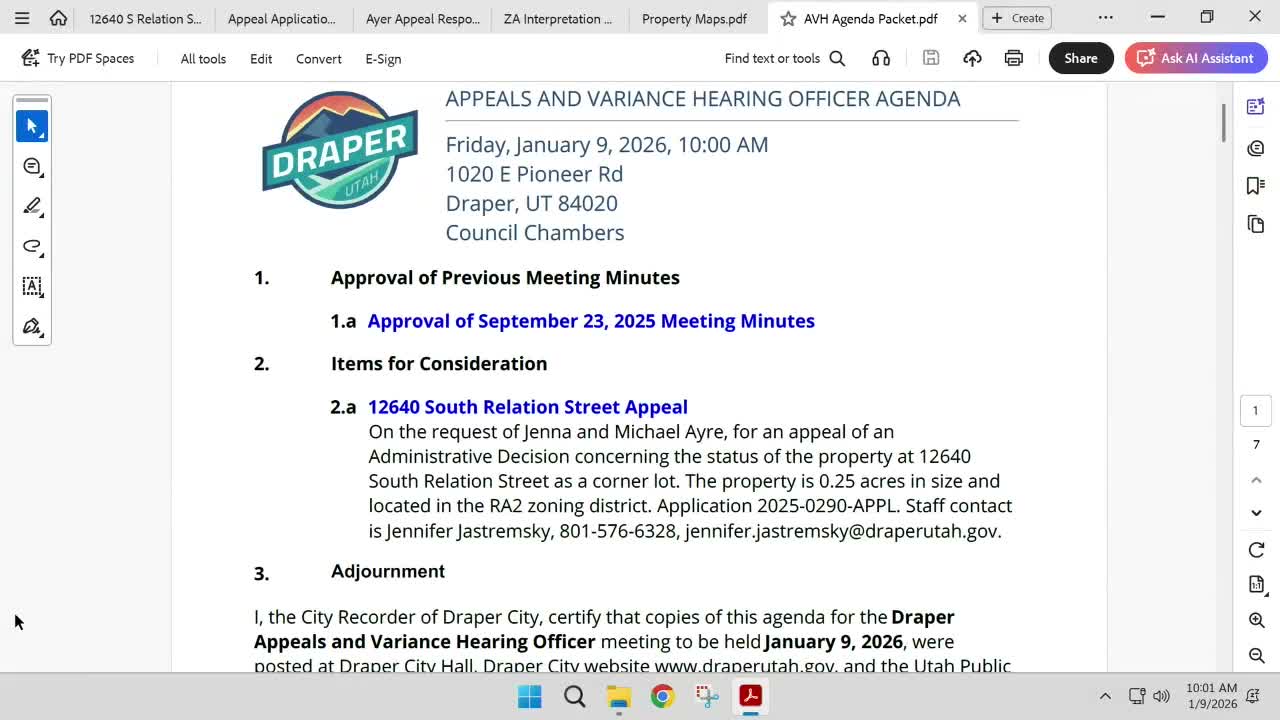
A pair of homeowners and their counsel told a Draper appeals and variance hearing on Jan. 9, 2026, that the city's zoning administrator incorrectly classified 12640 South Relation Street as a corner lot and that the determination should be reversed.
Appellant attorney and homeowners argued the city's interpretation rests on a single word''''''''''"abutment" and improperly treats that physical adjacency as dispositive. "If abutment alone were enough," an appellant said in the hearing, "then the city would be required to classify a wide range of parcels as corner lots simply because they touch or border something labeled a right of way." The appellants asked the hearing officer to confirm the parcel's status as an interior lot, which they said would mean a single 30-foot front setback from Relation Street, 12-foot side yards, and a 20-foot rear setback.
The city's representative countered with a plain-language reading of Draper's zoning code. Spencer Dushane, assistant city attorney, said the code defines a corner lot as a parcel that "abuts two streets" with an intersection angle of 135 degrees or less and that the city's GIS review shows the lot meets that test: "If so, it's by definition a corner lot," he said, adding the substantial-evidence standard for the zoning administrator's interpretation can be satisfied by the material in the administrative record.
A central dispute at the hearing was whether the 2000 Bakers Cove subdivision plat and the creation of June Circle automatically reclassified the parcel or whether such a reclassification would have required the subdivision to satisfy Title 17's mandatory corner-lot and developability standards. Appellants said the 2000 approval did not reconfigure or widen the lot in the manner Title 17 requires and therefore cannot be used to impose new corner-lot consequences now. They also presented examples of similarly situated parcels to test whether Draper has applied the abutment rule uniformly.
Appellants said earlier pre-purchase communications with city staff and their contractor indicated interior-lot setbacks. The appellants testified those communications, along with missed internal deadlines and divergent staff views, caused them to incur due-diligence costs and delays and would materially reduce the property's redevelopment potential and value if the corner-lot classification is sustained.
Hearing officer Tim Pack asked parties to limit factual supplementation because the appeal is a record-based review under DCMC 9-5-180(d)(4) but allowed both sides to present their legal arguments and the materials they relied upon; he reserved a final determination for a written ruling. The hearing was closed and Pack said he will issue a ruling sometime next week.
No formal vote was taken during the hearing. The primary relief sought by the appellants was reversal of the zoning administrator's corner-lot determination and confirmation that the parcel remains an interior lot subject to interior-lot setbacks.
The city and appellants both cited state and local authorities during argument. The hearing record shows references to Draper City Municipal Code (Titles 9 and 17; DCMC 9-5-180(d)(4); DCMC 17-5-20(f) re: corner lots), the Land Use Development and Management Act (LUDMA), and several court decisions (OutFront Media LLC v. Salt Lake City Corp., Kartchner v. Salt Lake County, Burmese v. Summit County, and Northern Monticello Alliance v. San Juan County).