Get Full Government Meeting Transcripts, Videos, & Alerts Forever!
Get email alerts on the Environment Water topic
No spam. Unsubscribe anytime.
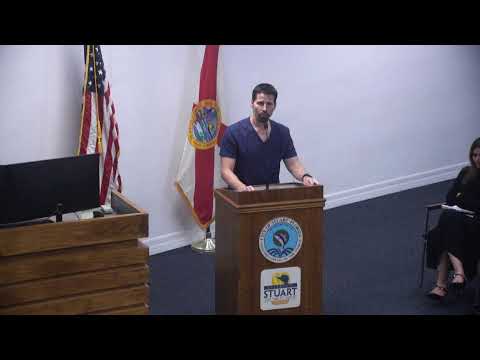
Army Corps outlines timeline for Everglades, Lake Okeechobee projects at Stuart commission meeting
Summary
Deputy commander Major Corey Bell briefed the City of Stuart Commission on South Florida restoration projects, including the Integrated Delivery Schedule release expected in March and completion targets for the EAA reservoir in 2029; he warned of seepage‑well work needed before full operation of C‑44 reservoir.
Major Corey Bell, deputy commander for the South Florida region of the U.S. Army Corps of Engineers, told the City of Stuart Commission the corps will tentatively release the final Integrated Delivery Schedule (IDS) in March and highlighted how several regionwide projects tie into ongoing efforts to restore the Everglades and manage Lake Okeechobee.
“The integrated delivery schedule…we're looking tentatively to release the final version of the IDS in March,” Bell said, explaining the IDS coordinates projects across the South Florida Ecosystem Restoration program. He described continuing work on the Lake Okeechobee Watershed Restoration Project, ongoing aquifer storage and recovery (ASR) research, and the C‑44 operational testing and maintenance phase, which saved roughly 25,000 acre‑feet of water in water year 2025.
Bell said the Army Corps and state partners aim to complete the EAA reservoir by 2029 and noted that the lake recovery operations conducted last year produced measurable ecological benefits, including increased subaquatic vegetation. He cautioned, however, that the C‑44 reservoir cannot yet be operated at its full 15‑foot capacity until seepage‑well design and construction address observed sloughing along the reservoir’s southwest seepage canal.
Commissioners pressed Bell for local impacts and tradeoffs. Bell acknowledged competing regional priorities — including West Coast interests that seek larger flows to the Caloosahatchee — and said the corps is partnering with the South Florida Water Management District to balance water supply, environmental outcomes and flood risk. On the prospects for reduced discharges to coastal structures, Bell said recent lake recovery operations could provide “a reset” that might forestall some releases for roughly five to six years under favorable environmental conditions.
The presentation concluded with a commitment to keep local officials informed as planning and operational details — including the next iteration of the Lake Okeechobee System Operating Manual — are developed.