Get Full Government Meeting Transcripts, Videos, & Alerts Forever!
Get email alerts on the Zoning Variance topic
No spam. Unsubscribe anytime.
Zoning board approves variance for 406–408 Ridge Avenue, conditions require engineered fire egress
Summary
The Allentown Zoning Hearing Board approved a variance allowing two additional apartments at 406–408 Ridge Avenue but conditioned permission on an engineered fire‑egress solution (sprinklers or an approved alternative) and egress windows, citing lot constraints and neighborhood context.
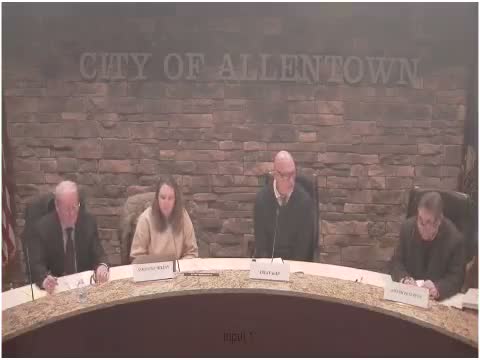
The Allentown Zoning Hearing Board on an evening hearing approved variances to permit two additional dwelling units at 406–408 Ridge Avenue, but required the owner to submit engineered, stamped plans demonstrating a code‑compliant fire‑egress system before permits are issued.
Chair Samantha McLean opened the matter and noted the city had entered an appearance as an interested party. Mike Hanzo, zoning supervisor for the City of Allentown, told the board the city’s concern was principally building‑code and life‑safety issues, not the residential use itself. "The property in question is essentially landlocked," Hanzo said, and the city provided a presale inspection report and a stop‑work order among its exhibits.
Owner Mr. Carometti, who purchased the building in July 2022, testified he hired an architect and began demolition to rehabilitate the first floor. Architect Stuart of Galc Architects, qualified as an architectural expert, described options for meeting egress requirements, noting one common path is to equip the building with an automatic sprinkler system to allow a single exit provision for the proposed unit count. "If the building is sprinkled," Stuart said, "you're allowed to have up to four units per floor and those units could access one exit per the code table we rely on."
Board members weighed the neighborhood context — a mix of multifamily and commercial uses — against technical constraints including a small lot footprint (the lot was stated as roughly 2,525 square feet) and the lack of on‑site parking. One board member said city staff should assess any engineered alternative but insisted on a durable safety solution: "The building must be sprinklered and the windows in all the bedrooms must be egress windows," the member said, adding the board would accept an alternative if the city’s building official deemed it equivalent.
The board’s motion conditionally approved the requested dimensional relief and variances, with conditions requiring compliance with the currently adopted building code, submission of stamped engineering plans showing an acceptable fire‑egress solution (sprinklers or an approved alternative), and provision of emergency‑escape windows where required. The board recorded the approval on a voice vote.
The board and parties acknowledged prior appeals on the same property in the early 2000s but said current code changes (notably sprinkler requirements) and the owner’s stated plan to bring the building up to code informed their decision. Counsel for the city and the applicant agreed the zoning approval should precede detailed building‑code work so that engineering and permitting would follow the board’s decision.
The board concluded the conversion would produce housing while requiring mitigations to address life‑safety concerns; the owner must return to the building‑permit process with stamped plans acceptable to the city’s building official.