Lifetime Citizen Portal Access — AI Briefings, Alerts & Unlimited Follows
West Virginia University researcher says combined LIBS and electrochemical sensors can speed gunshot-residue screening
Loading...
Summary
Dr. Tatiana Trejos presented validation results showing that combining laser-induced breakdown spectroscopy (LIBS) and electrochemical sensors can rapidly detect gunshot-residue (GSR) elements on hands, improve discrimination versus non-shooter samples, and remain compatible with SEM–EDS confirmation; she said expanded studies are ongoing.
Dr. Tatiana Trejos, an assistant professor in the Department of Forensic Investigative Services at West Virginia University, presented validation results showing that two portable technologies—laser-induced breakdown spectroscopy (LIBS) and electrochemical sensors—can speed and improve screening for gunshot residue (GSR).
“I'll be talking about the identification of organic and inorganic residues using electrochemical and spectrochemical methods,” Trejos told attendees, arguing that laboratory analysis often lags behind field detection systems and that faster screening could help investigators and reduce evidence backlogs. She noted that many U.S. cities now use real-time acoustic gunfire detection systems, while laboratory results for GSR can currently take weeks.
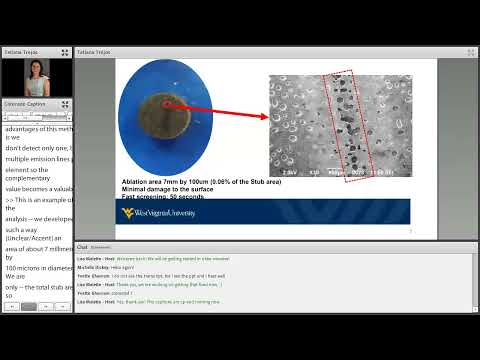
Trejos described LIBS as a pulsed-laser direct-analysis technique that produces both quantitative and qualitative data in under a minute with minimal sample destruction, and electrochemical sensors as low-cost, portable devices that detect inorganic and organic species by inducing redox reactions at an electrode. "The analysis is very rapid," she said, adding that the two methods are complementary: "when we combine the information provided by both methods, which is orthogonal, we can observe a high increase in the specificity, sensitivity, and accuracy."
In the study Trejos presented, the team evaluated 112 samples: she reported 20 samples originated from non-shooters and 28 from shooters' hands collected after firing three different firearm types in both indoor and outdoor settings. She defined true positives as samples from shooters that showed positive results for lead, barium or antimony (or at least two of those three elements) and true negatives as non-shooter samples below the threshold. Trejos said box-plot distributions for lead, barium and antimony in her dataset showed clear separation between shooter and non-shooter samples.
Trejos described two sampling workflows. One used a disposable electrode about 1.5 centimeters long that can be applied directly to the hand and produce a detectable signal in under a minute. The other adapted the conventional carbon-stub sampling used for SEM–EDS by applying a microextraction (using ammonium acetate) from a portion of the carbon stub onto an electrode, enabling compatibility with existing GSR collection kits. She noted the LIBS ablation removes only a tiny fraction of the stub area, allowing follow-up SEM–EDS when confirmatory particle analysis is needed; she reported individual LIBS analyses can take about 50 seconds.
On performance metrics, Trejos said the team estimated false positive and false negative rates as well as sensitivity and specificity for each method and for the combined approach, but she did not present numerical error-rate values during the talk. She emphasized that the combination of LIBS and electrochemical sensing—because they measure different physical properties—improved discrimination over either technique used alone.
Beyond hand swabs, Trejos described LIBS-based chemical mapping around entrance holes and a rastering approach that monitors element concentration as a function of distance from a crater to aid distance-of-fire analysis and to produce high-resolution 3-D chemical images for courtroom presentation. She said these maps can be useful on dark or damaged surfaces and can detect multiple elements simultaneously, which can be important for lead-free ammunition or complex scenes.
Trejos concluded that the methods "have the potential to provide a transformative alternative to firearm discharge residues" for screening, particularly in mobile laboratories or field deployments that aim to reduce laboratory backlogs. She estimated a simple screening run for an individual's hand could take about 1–3 minutes and that, in an example with four samples per hand plus a control, screening by both methods could take roughly 15 minutes.
During a brief question-and-answer period, an audience member asked whether the approach could be extended to successive projectile impacts through barriers. Trejos said the group is conducting an expanded study testing different primers and configurations and that they have successfully detected non-lead primers in some combinations.
Trejos acknowledged students and colleagues Dr. Keith Morris and Robert O'Brien from the Ballistics Laboratory at West Virginia University for assistance with sample collection. The research team said further validation work is underway.