Lifetime Citizen Portal Access — AI Briefings, Alerts & Unlimited Follows
Boston Police trace-evidence team details validation of new JEOL SEM and plans for gunshot residue analysis
Loading...
Summary
Miss Reynolds of the Boston Police Department outlined validation tests for a recently acquired JEOL scanning electron microscope with Oxford EDS, reporting instrument calibration, probe-current stability, and steps to validate gunshot primer residue analysis, including negative controls and training plans.
Miss Reynolds, Criminalist 4 in charge of the Trace Evidence Section at the Boston Police Department Scribe Lab, told colleagues the lab validated a recently acquired JEOL scanning electron microscope (SEM) with Oxford Energy-dispersive X-ray Spectroscopy (EDS) and has begun a validation program for gunshot primer residue (GSR) analysis.
She said the lab received the instrument in July 2016 and “we were able to get a JEOL SEM with Oxford EDS,” then outlined a stepwise validation plan that began with trace-evidence proficiencies (tape, paint, glass) before moving into GSR. The lab used peer validation outlines from the Massachusetts State Police and from Matney Wyatt at USACIL, together with vendor guidance, to develop its protocols.
Miss Reynolds described key calibration checks: magnification and measurement verification using a Pelco standard (including a copper grid with an accepted value of 127 microns), factory-resolution checks using a manganese standard (full-width half-maximum measured across spectra), and x-ray energy-range verification (molybdenum peaks near 2.266 keV and 17.446 keV). For probe-current stability — important for long GSR runs — the lab implemented a practical Faraday-cup workaround using an aperture and collected about 9.69 hours of data, reporting a roughly 2.6% max-to-min variation over the run (≈0.28% per hour), which Miss Reynolds said met the manufacturer’s guidance.
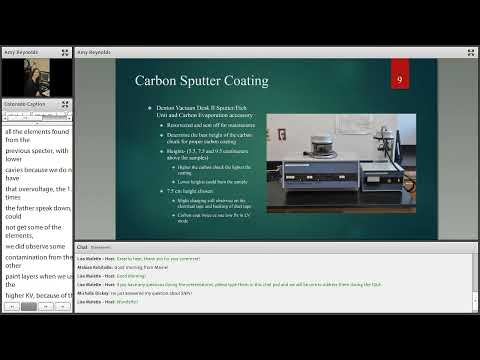
To compare the new instrument with the laboratory’s prior system, the team reran existing proficiency items. Glass proficiencies reproduced the expected major peaks; automotive paint returned additional peaks with the new detector; and some tape results differed, likely because older runs lacked carbon coating and showed charging. The lab repaired and tested an existing sputter coater, set a carbon-chuck distance near 7.5 centimeters for even coating, and concluded some samples require double coating or low-vacuum imaging to reduce charging.
For GSR validation the lab used a Plano standard and tuned parameters to achieve a target detection of more than 90% of particles larger than 1 micron. Reported working parameters that produced good detection included a 2 μs first-pass imaging setting, a gray-level threshold of 8,800, and a magnification of about 250x; second-pass imaging was 20 μs. For EDS the team used 0.5 seconds for non-lead elements and an extra 1.5 seconds (a filter) when lead was present to ensure adequate counts.
Miss Reynolds said the lab conducted a negative-control check by placing five SEM stubs in different rooms; none showed primer residue. She also described a software limitation encountered in an older Oxford/Aztec release (v3.3) that prevented manual reacquisition of small particles; upgrading to Aztec v3.4 enabled manual reacquisition down to about 1 micron. A timed “weapon-in-time” study using five guns and sampling at 0, 2, 4 and 6 hours after firing showed high particle counts immediately post-shot and a decline at later times, with reacquisition possible down to roughly 1.3–3 microns depending on the run.
Miss Reynolds said the SEM had been adjacent to a former gunshot-distance room, so the lab performed deep cleaning and resampling to assess contamination and relocated the gunshot-distance function. She described training and competency plans that include operator trainings, a GSR identification course, workshops (brake pads, fireworks) and mock-case proficiencies leading to a mock trial.
In a brief question-and-answer period, Miss Reynolds described daily startup checks — filament ramp, wobble/alignment/tilt/shift and a targeted load current around 65 for QC — and confirmed the lab does not use a commercial Faraday cup but used an aperture-based method for the probe-current study. The session ended with an invitation to continue technical questions during the break.
Next steps: the lab will complete contamination stub runs and finalize written protocols and competency checks before offering GSR results for casework.