Get Full Government Meeting Transcripts, Videos, & Alerts Forever!
Get email alerts on the Quantum Computing topic
No spam. Unsubscribe anytime.
IBM fellow details quantum progress, warns of encryption risks and urges higher-education workforce planning
Summary
IBM fellow Ray Harishankar told a Midwestern Higher Education Compact audience that quantum computing is maturing—showing industry wins in finance and chemistry—while urging higher-education programs and two‑year pathways to prepare a workforce and to adopt post‑quantum cryptography ahead of projected risk timelines.
Ray Harishankar, an IBM fellow at IBM Research, told a Midwestern Higher Education Compact audience that quantum computing has moved from laboratory demonstrations to practical, industry-led experiments and that colleges should expand curricula and pathways to meet growing workforce needs.
"Our mission statement is we bring useful quantum computing to the world and to keep the world quantum safe," Harishankar said, framing both application opportunities and the security challenge posed by quantum advances.
Harishankar described how qubits—quantum bits that can represent values between 0 and 1—enable different algorithms than classical computers, calling out superposition, entanglement and interference as the physics that power those algorithms. He illustrated the information-scaling effect of qubits, noting that 49 qubits reach the representational power of top supercomputers and that IBM's Heron processor currently runs at 156 qubits.
He cited commercial and research milestones to show practical use cases: IBM placed a five‑qubit machine on the cloud in 2016 and now offers roughly 85 quantum computers on its cloud, he said, and companies including HSBC, Vanguard and Wells Fargo have published peer‑reviewed work reporting performance gains from quantum‑classical workflows (Harishankar highlighted HSBC's reported 34% improvement on a trade‑field predictor). He also described a 2024 demonstration that paired IBM's Heron processor with Japan's Fugaku supercomputer to tackle chemistry‑modeling problems.
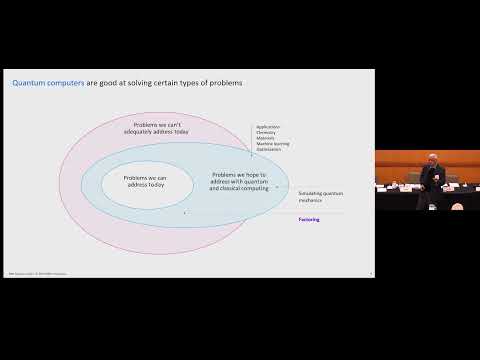
Those technical advances, Harishankar said, create both opportunity and risk. He warned that quantum algorithms can factor large numbers that underlie common public‑key systems and that government guidance has set readiness goals; he summarized the risk window by referencing a U.S. government timeline aimed at preparedness by 2033 and IBM's internal roadmap to increase logical‑qubit capacity toward 200 by 2029 and to scale further into the early 2030s.
"That encryption is based on this factorization," Harishankar said. "RSA‑2048 … even if you put a supercomputer to work, it would take a very long time. But quantum can do it in a matter of hours." He described his work as focused not on breaking encryption but on "fixing it" through post‑quantum cryptography.
He stressed the workforce gap: quantum applications require three skill sets—foundational quantum programming and algorithms, industry/domain knowledge to map algorithms to real problems, and hybrid interdisciplinary skills. Harishankar recommended higher‑education engagement at multiple levels, including bachelor's and graduate programs and shorter technical pathways such as P‑TECH–style two‑year diplomas, and said IBM shares starter curriculum materials with universities.
On energy use, Harishankar responded to audience concerns that quantum facilities would strain power grids by explaining that most energy cost is cooling qubits to millikelvin temperatures; once cooled, operating power is modest—he estimated roughly 60–120 watts for the quantum hardware itself—and compared that to the large cooling and power loads of GPU‑based data centers.
Harishankar pointed to existing institutional partnerships and installations—Cleveland Clinic, RPI and selected international sites—and described about 30–40 quantum innovation centers focused on research, ecosystem building and workforce training. He said Cleveland Clinic and partners have secured funding to develop degree programs and curricula and mentioned a reported $7,000,000 funding award to support curriculum development across bachelor's, master's and Ph.D. levels.
The presentation closed with an offer of materials and curricula for attendees and a brief Q&A on pathways and timing. Harishankar said IBM is building a data center in Poughkeepsie to scale quantum capacity and reiterated urgency for education and defensive cryptography planning.
The session ended after audience questions; Harishankar said additional materials are available for attendees and that IBM will continue collaborating with universities and regional partners.