Lifetime Citizen Portal Access — AI Briefings, Alerts & Unlimited Follows
Lincoln Electric highlights large-scale metal 3D printing, cites Oak Ridge National Laboratory collaboration
Loading...
Summary
Lincoln Electric presenters described using wire-arc additive manufacturing to print large metal parts, citing a Soo Locks example that reduced replacement lead time from about 72 weeks to 12 weeks and crediting Oak Ridge National Laboratory for demonstration and development support.
Speaker 1 said Lincoln Electric was founded by John Lincoln in 1895 and noted the company’s shift from motors to electric arc welders and, more recently, wire-arc additive 3D printing. "That's 130 years ago this year," Speaker 1 said.
Speakers described how arc welding — forcing current through a small wire until it melts — is being adapted for large-scale 3D printing. "In 3 d printing, from a a very fundamental stance, you've got a material, you've got some method to deposit the material, and then you've got a a motion system to put it where you want it to go," Speaker 2 said, outlining the process steps of materials, deposition, motion control and software.
The presenters emphasized material breadth: "stainless steels, nickel based, copper based, aluminum, titanium," Speaker 3 said, noting the technology can produce complex geometries and mix materials in ways difficult for conventional methods.
Several speakers framed the technology as important for energy and national-security infrastructure. "If we can't replace a hydro impeller in a dam that goes bad, if we can't replace or make nuclear reactor components and we have to source everything abroad, then we have a big big challenge as a country," Speaker 4 said, describing supply-chain risk when large components have very long replacement lead times.
As a concrete example, Speaker 5 described work for the Soo Locks in Sault Ste. Marie, Michigan, managed by the United States Army Corps of Engineers. He said a 60-year-old mechanical arm developed cracks; traditional castings had about a 72-week lead time, while the printed solution arrived much faster. "We printed it in 2 pieces and it was a 12 foot long 6,000 pound part, the whole thing was delivered in 12 weeks," Speaker 5 said, using the example to underscore time savings for a strategically important Great Lakes corridor.
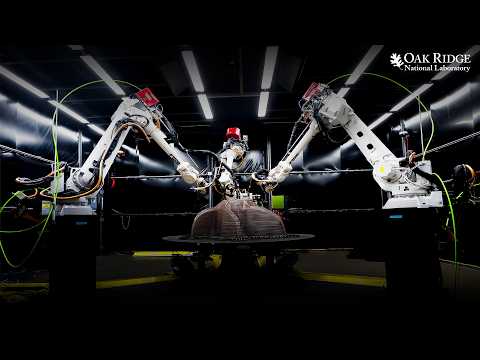
The technical team also discussed production limits and system design. Single deposition heads were described as limited to roughly "10, 15 pounds an hour," prompting development of multiple-head systems to raise throughput. Speaker 3 pointed to the 'Medusa system' behind him as a new-generation manufacturing platform with multiple robotic arms performing deposition, cleaning, grinding and other tasks under system control.
Speakers said artificial intelligence can optimize how robots lay down material to accelerate production while ensuring required material properties. "We can use things like artificial intelligence to be able to optimize the way that those robots lay down material in order to both accelerate the process, but also make sure that we ensure good material properties and performance," Speaker 4 said.
Multiple speakers credited Oak Ridge National Laboratory with demonstration and development support. "The Oak Ridge National Lab was able to to show us and and help really explore the application space and show what is possible," Speaker 2 said, and later reiterated the company worked "with the many scientists and engineers at the lab to help really explore the application space."
The presentation framed large-scale metal additive manufacturing as a means to shorten lead times for critical infrastructure parts, increase domestic manufacturing resilience and deploy advanced automation and AI in U.S. production. No formal votes or policy decisions were recorded during the session.