Lifetime Citizen Portal Access — AI Briefings, Alerts & Unlimited Follows
House Tax Committee hears overview of federal 'OBAA' conformity and shows $388M biennial cost estimate
Loading...
Summary
House Research and House Fiscal told the House Tax Committee that mechanically conforming Minnesota law to major federal changes in the 'One Big Beautiful Act' (OBAA) would reduce the general fund by an estimated $387.99 million in fiscal 2026–27, with a later estimated net revenue gain of about $89.82 million; members raised questions about R&D expensing, childcare credits and long-term effects.
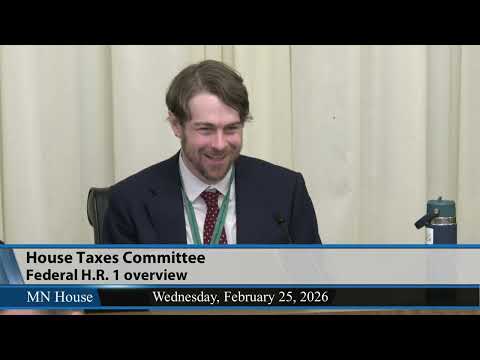
Sean Williams of House Research told the House Tax Committee on Feb. 24 that Minnesota is a static-date conformity state and currently ties its tax code to the Internal Revenue Code as of May 1, 2023. He said updating that reference—"mechanical conformity"—would automatically import federal changes that affect adjusted gross income or federal taxable income and that not all federal changes would flow to state law because some items occur after AGI or because of state opt-outs.
Williams summarized several federal provisions in the law he and his colleague Chris Klayman called the One Big Beautiful Act (OBAA). He said conforming to OBAA would have mixed effects on Minnesota revenue depending on the provision: expanding dependent-care FSAs and certain 529 distributions would reduce general fund revenue, while items such as the denial of duplicate deductions (the federal "double benefit" rule tied to expanded employer childcare credits) would raise revenue after mechanical conformity.
Cynthia Templin of the House Fiscal Analysis Department presented fiscal estimates based on the Department of Revenue's numbers and the House fiscal spreadsheet. She told the committee the Department of Revenue estimates that full mechanical conformity would produce an estimated general fund revenue reduction of $387,990,000 in the fiscal 2026–27 biennium and an estimated revenue gain of $89,820,000 in later years. Templin highlighted that the largest near-term fiscal costs were concentrated in business extenders and expensing provisions (notably accelerated R&D and bonus depreciation), while revenue gains were concentrated in childcare and certain international provisions such as GILTI-related changes.
Klayman reviewed business provisions that drive much of the front-loaded fiscal impact: permanent 100% bonus depreciation (with a state five‑year add‑back that creates timing differences), expanded expensing for research and experimental expenditures (including a retroactive component), opportunity‑zone changes, and adjustments to business loss rules and wagering loss limits. He said many of those provisions change the timing of deductions and therefore can create large costs in the first biennium that may net to different outcomes outside the budget window.
Committee members pressed staff on timing and scope. Representative Johnson asked whether R&D expensing changes were one‑time or ongoing; Templin and Klayman said the provision has retroactive elements that front‑load costs and permanent elements that could affect later years. Representative Freiberg asked where the pass‑through entity (PTE) issue appeared in the spreadsheet; Templin pointed to page 3 and said mechanical conformity shows no net PTE cost because Minnesota's prior PTE authority has expired, though a standalone state deduction could have costs.
Chair Gomez framed the committee's work in broader policy terms and criticized the federal law in stark terms, saying it added trillions to the federal deficit and would have distributional effects. Gomez's remarks were presented to the committee as a policy perspective rather than an administrative or fiscal finding.
The committee did not take formal action on conformity at the hearing; staff and members indicated the issue will return for further analysis and that members may request additional briefings. House Research and House Fiscal staff provided packet materials and spreadsheets for members to review.
Next steps: Committee chairs said work on conformity will continue, with additional hearings and committee time scheduled; no vote was taken on mechanical conformity during this meeting.