Get Full Government Meeting Transcripts, Videos, & Alerts Forever!
Get email alerts on the Bwetpro Reporting And Compliance topic
No spam. Unsubscribe anytime.
HRSA orients 105 BWET PRO grantees on new reporting rules, NPI requirement and deadlines
Summary
HRSA’s Bureau of Health Workforce told 105 Behavioral Health Workforce Education and Training for Professionals (BWET PRO) awardees in a webinar that project years run FY2025–2029, total funding is $59,300,000, NPIs will be required for stipended trainees, and key deliverables include a Standardized Work Plan due Sept. 5 and the Annual Performance Report due July 31.
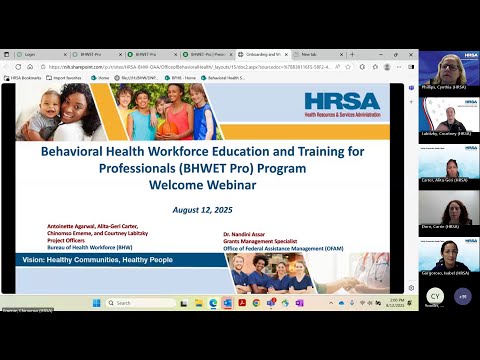
The Health Resources and Services Administration’s Bureau of Health Workforce held an orientation webinar for recipients of the Behavioral Health Workforce Education and Training for Professionals (BWET PRO) grants, outlining program goals, reporting requirements and near-term deadlines.
"On behalf of HRSA's Bureau of Health Workforce, we want to extend our congratulations to you all, both new and returning awardees," said Cynthia (Cindy) Phillips, director of behavioral health workforce initiatives at HRSA. Phillips said the project period runs from fiscal year 2025 through 2029 and that the agency awarded 105 programs with total funding of $59,300,000.
Why it matters: BWET PRO supports training to expand the behavioral health workforce in high-need and underserved communities. The webinar explained what grantees must do to comply with federal reporting, complete required deliverables and avoid validation errors that could delay future reporting.
Key details and deadlines
- Standardized Work Plan. The SWP is a condition of the award and must be entered into HRSA’s Electronic Handbooks (EHB) interface (not merely uploaded as an attachment). Presenters said grantees must assign a project director in EHB to generate the SWP task; it may take several days for that task to appear. The program team asked grantees to submit the SWP by Sept. 5 and to resolve any other award conditions by Sept. 15.
- Quarterly Progress Update (QPU). The first QPU will be generated in EHB and is due Oct. 15, the presenters said.
- Annual Performance Report (APR). Presenters said the APR is a major quantitative report due July 31 each year and requires program- and trainee-level data: trainee enrollment, demographic details, contact hours, training-site addresses and counts, and course and faculty development metrics. The team emphasized collecting individual-level patient encounter data rather than only cohort totals.
- Carryover and no-cost extensions. Competing continuations that want to carry over unobligated funds must submit a prior-approval request in EHB; carryover becomes available after the Federal Financial Report (FFR) is submitted and must be requested within 30 days of the FFR. A no-cost extension (NCE) is separate and applies when activities extend past the final budget period date.
NPI requirement and data collection
Presenters said that beginning with this award cycle grantees must collect National Provider Identifier (NPI) numbers for all stipended trainees before the end of the first training year. "This is required," the team said, and noted that students are eligible for a student taxonomy of NPI and can apply while still in training. If an NPI is not yet available, grantees may enter a 'not reported' code and update it later; HRSA staff offered technical assistance for validation errors.
Program objectives and staffing
Speakers reviewed four core BWET objectives from the Notice of Funding Opportunity (NOFO): expanding community partnerships for experiential training, promoting interprofessional team-based training and behavioral health integration, growing a qualified workforce to serve children and youth, and recruiting and training clinical supervisors. The presenters also introduced program staff and project officers assigned by discipline to assist grantees with reporting and program implementation.
Other guidance and resources
Staff reiterated HRSA’s plan to transition grant management to a new platform (GrantSolutions) over time but said the EHB remains the mechanism for current reporting. The presenters promised to share the slide deck and recording after the webinar and pointed participants to data.hrsa.gov to search grantee abstracts and identify peer programs.
What comes next
Project officers will follow up with grantees to set up bimonthly calls. Grantees were encouraged to consult the SWP template in the onboarding reference guide (the template standardizes goal and objectives language and includes a fifth objective for data collection; presenters said the fifth objective is not a new requirement but a restructuring for standardization). Court and technical contacts for EHB tier-2 support were listed in the slide materials.
"We will provide technical assistance in all of that throughout the year," Phillips said.
The agency closed the webinar after answering remaining questions and said slides and the recording would be distributed to awardees.