Get Full Government Meeting Transcripts, Videos, & Alerts Forever!
Get email alerts on the Land Use topic
No spam. Unsubscribe anytime.
Bexley council reopens hearing on 519 South Drexel use-variance request; no decision
Summary
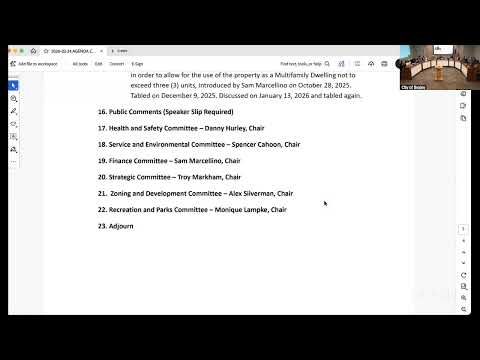
Council heard a contested use-variance request to convert 519 South Drexel from a bed-and-breakfast to a three-unit multifamily building. Applicant’s attorney argued the 1924 building and surrounding uses constitute an extraordinary hardship; council took the application under advisement and tabled the ordinance for another meeting.
A public hearing on a use-variance request for 519 South Drexel drew a packed council chamber on Feb. 24 as counsel for the property owner argued the building’s age and configuration warrant conversion from a bed-and-breakfast to a three-unit multifamily dwelling.
Craig Moncrief, an attorney with the Plank law firm representing the owner, told council the house was built about 1924 and functioned historically as a multifamily property. He said the structure already contains three developed floors, multiple kitchens and separate living areas and that conversion would require no exterior changes. Moncrief argued the application satisfies the seven factors in Bexley’s zoning code for a use variance, including that the property’s physical characteristics and surrounding land uses make strict application of the R-3 single-family rules an “extraordinary circumstance.”
City building and planning director Matt Klingler summarized staff findings and a timeline of events: the property’s deed transferred Aug. 11, 2025; the city received an initial inquiry in mid-August and a formal application Aug. 29, 2025; and staff identified adjacent nonconforming multifamily uses that could prompt rezoning but noted council previously opted to handle the request as a variance. Klingler’s written staff report flagged parking (the site has the off-street space to meet R-12 multifamily standards) and provided the use-variance criteria for council review.
Opposing counsel Krusita Fletcher (speaking for unidentified interested parties) confirmed some financial information provided to the applicant was under nondisclosure and said more economic detail was sealed. Several council members pressed for fuller financial documentation and probative occupancy data to assess whether the property could be put to a viable permitted use under current zoning. The applicant provided a ledger showing month-by-month occupancy since June 2025 and agreed to mark it as an applicant exhibit for the record.
One nearby resident asked whether the third floor would be converted into a separate unit and whether any exterior additions were planned; Moncrief said the third floor is already developed with a bathroom and kitchen facilities and would be used as a unit with interior work only. Staff confirmed a zoning-violation letter had been issued after the city learned the owner was not living on the premises as the previous bed-and-breakfast condition required; Klingler said the owner was given time to remediate and the hearing falls within that compliance window.
President Saad closed the public hearing at 8:05 p.m. and moved to place Ordinance 28-25 back on the table for final consideration at a future meeting. No vote on the variance was taken on Feb. 24.
Next steps: council will review the full record, including the applicant’s exhibits and any supplemental financial evidence, before deciding whether to grant the use variance, pursue a rezoning of the corridor, or take other action at a subsequent meeting.