Lifetime Citizen Portal Access — AI Briefings, Alerts & Unlimited Follows
Cathedral City council hears appeal of C4 dispensary denial as neighbors press for enforcement over persistent odors
Loading...
Summary
At a Feb. 25 public hearing, staff defended the denial of a local dispensary renewal under ordinance 8-70 citing insufficient continuous operation and record discrepancies; the appellant said August tax returns show sales and that a temporary safety closure explains gaps. Residents pressed council to enforce odor rules tied to C4 and other facilities. No final decision in the transcript.
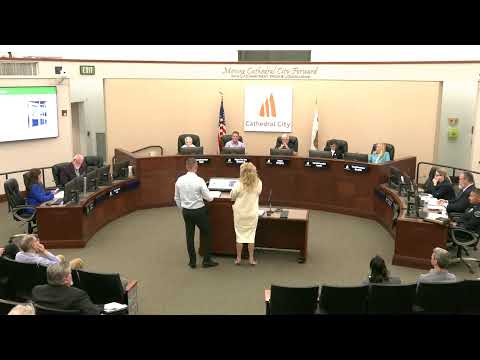
The Cathedral City City Council on Feb. 25 held a public hearing on an administrative appeal by CC Industry LLC (doing business as C4 USA) after staff denied renewal of its dispensary portion of the cannabis license under ordinance 8‑70.
The dispute centers on how the municipal code’s renewal test defines "the previous month" and whether the dispensary was an operating retail business during the relevant period. Financial Services Director Kevin Biersack told the council staff had found limited sales records, inspection notes showing missing signage and no evidence of an operating retail storefront on Oct. 13, and a Nov. 11 notice from the operator saying dispensary operations had ceased that day.
City Attorney Vale, explaining the hearing’s scope, told the council that the matter is quasi‑adjudicatory and that the decision must be based on evidence relevant to the license renewal; "This is not about odor. Odor is not relevant in this in this case," Vale said. The staff presentation focused on municipal code section 5.88.055 (ordinance 8‑70) and the revenue code (chapter 3.48) that governs tax returns and reporting periods.
Multiple residents used the public‑comment period to press the council for stronger enforcement of the city’s odor rules and for limits on C4’s expansion. Janet Ream and others described recurring odors attributed to nearby cannabis operators, calling the impacts "horrific" and saying the smell can make residents sick or keep children from outdoor activities. Nancy Bosoyan, who reviewed the council packet, asked the council not to permit a planned Phase 2 build‑out at C4 until emissions from Phase 1 were demonstrably controlled; she said C4 had 200,000 square feet and was permitted for an additional roughly 150,000.
Appellant counsel Lisa Slaughter told the council the operative standard for this renewal is the first‑renewal rule (requiring proof of commercial cannabis activity in the previous month) and that C4 met it. Slaughter submitted an August 2025 tax return signed Sept. 4 showing $409.50 in sales and said the company reported the required transactions to the state Metrc system. She argued that a temporary closure beginning Sept. 13 to install perimeter fencing for safety explained a gap in visible operations and that staff’s later communications (including an Oct. 17 email from staff stating they had not taken steps to cancel the license while it was under review) created uncertainty the company attempted to resolve in good faith.
David Bernard, representing C4 operations, said the dispensary had a ramp‑up period in August with modest sales while inventory and staffing scaled up; he said the business employed three full‑time staff during the initial period and planned to reach six at full capacity. Bernard said some October and November transactions showed resumed retail activity until the city’s Nov. 11 notification.
Staff described discrepancies between tax returns and Metrc entries (for example, the August tax return reported $409.50, while Metrc initially listed items totaling about $160 that were later adjusted), and said those inconsistencies are the type of matters a city audit would examine. Kevin Biersack explained that the municipal revenue code requires returns "before the last day of the month following the close of each calendar month" unless the city manager sets a different reporting period, and acknowledged staff’s prior interpretation (counting 30 days back from the renewal date) differs from a calendar‑month reading.
Council members asked clarifying questions about the meaning of "month" in the code, the adequacy of tax returns as proof, the role of business‑license inspections and punch‑list corrections (signage, hours), and whether a temporary public‑safety closure is an allowable reason for a lapse in continuous operation. Staff and the appellant disagreed over which subparagraph of the ordinance applied (first renewal under 4(a) versus the 12‑month continuous operation test for subsequent renewals under 4(b)), a dispute that goes to whether the operator could satisfy the renewal requirement.
No final council action is recorded in the provided transcript. The hearing included an extended staff presentation and an appellant opening; the council had not yet moved to deliberation or vote by the end of the supplied record. The council had earlier approved its consent agenda by motion of Mayor Pro Tem Gutierrez, seconded by Council Member Lam, carried by unanimous vote.
What’s next: the council will continue the public hearing and must decide whether to affirm, reverse or modify the staff decision to deny renewal of the dispensary license; if the council finds deficiencies in the record it may request additional evidence or clarify the municipal code interpretation before voting.
(Reporting note: quotes and attributions are drawn from the public hearing transcript; the hearing included technical references to municipal code 5.88.055 and revenue chapter 3.48, and to the state Metrc tracking system.)