Get Full Government Meeting Transcripts, Videos, & Alerts Forever!
Get email alerts on the Access And Functional Needs topic
No spam. Unsubscribe anytime.
Jefferson County official urges everyday inclusion of access and functional needs in preparedness
Summary
Allison Wilson of Jefferson County Public Health told an NNLM Region 4 webinar that simple, low‑cost accommodations and targeted staff training can make services and emergency response more accessible; the county reports 95% of trained staff could identify AFN and name at least one support item.
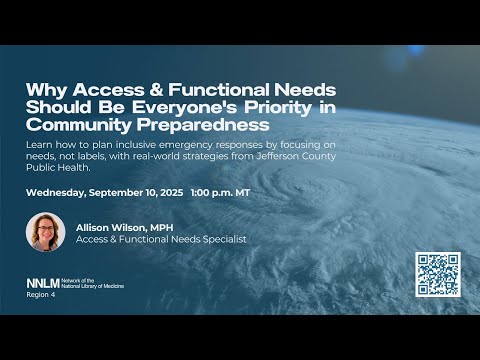
Allison Wilson, an access and functional needs (AFN) public health specialist with Jefferson County Public Health, told attendees of the Network of the National Library of Medicine’s (NNLM) Region 4 webinar that AFN should be embedded not only in emergency plans but in day‑to‑day services.
Wilson, speaking to library and public health staff across the nine‑state Region 4 network, described a shift in Jefferson County from treating accessibility as an “add‑on” to making inclusion the default. She said a 2019 review followed by a 2022 small grant helped the county integrate AFN into emergency plans and staff training, and a subsequent internal survey (about 80 responses from roughly 150 department staff) showed 95% of trainees could define AFN and identify at least one accommodation the department provides.
Wilson recommended starting with low‑cost, tangible items that staff can keep at front desks or check out for events — examples she demonstrated in a short video included simple whiteboards and communication sheets (available in English and Spanish), pen grips, noise‑reducing headphones, small magnifiers and colored reading strips. She said these items often meet needs that individuals will not explicitly request if they are not visible or offered.
For situations that require more robust assistive technology, Wilson described the county’s procurement of UB Duo units, a two‑part radio‑frequency typing device that allows private text communication without internet access; she said the devices are near $3,000 each and were acquired through grant funds and vacancy savings and then placed into a county‑wide checkout process.
Wilson also highlighted a Pocketalk translator device the county uses at front desks when bilingual staff are unavailable. For children and events, Jefferson County packages pediatric comfort kits with fidget items and quiet activities that can help regulation during stressful incidents or long lines.
Beyond equipment, Wilson urged organizations to ‘‘hear from’’ people with lived experience. She said the county plans to convene a volunteer advisory group that will meet monthly (for about nine months) to surface priorities from people who identify with AFN communities and to inform preparedness and recovery work.
Wilson credited partnerships — including libraries, the University of Colorado Denver’s Center for Innovative Design and Engineering and the state AFN team in Colorado — for helping the county scale training and outreach. She offered to share a Google resources sheet with item costs, supplier links and training materials, and said the webinar recording and slides would be emailed and posted to YouTube for attendees.
During a final Q&A, attendees asked about replicating Jefferson County’s approach; Wilson recommended beginning with a short survey of staff needs and then piloting a modest set of items and training sessions. She emphasized that many AFN accommodations are inexpensive and that pooled purchasing or grant funding can cover higher‑cost devices.
The NNLM Region 4 webinar was moderated by Lauren Wittick, communication specialist for Region 4 at the University of Utah; organizers said slides, a recording and resource links would be shared with registrants.