Get Full Government Meeting Transcripts, Videos, & Alerts Forever!
Get email alerts on the Disaster Preparedness topic
No spam. Unsubscribe anytime.
Curator Joanne Zeiss urges libraries to adopt practical disaster plans, templates and recovery kits
Summary
Joanne Zeiss, curator of the Waring Historical Library at the Medical University of South Carolina, presented a webinar outlining concrete steps libraries can take to prepare for natural disasters, including risk-mapping tools, pocket response templates, emergency 'go' bags and salvage procedures for water-damaged collections.
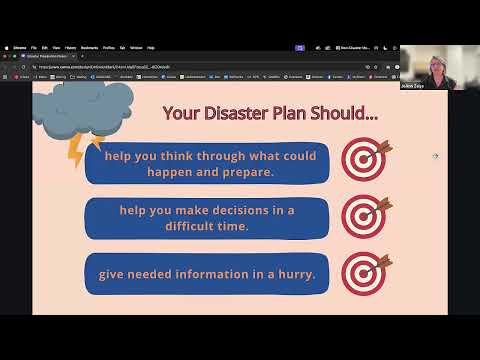
Joanne Zeiss, curator of the Waring Historical Library at the Medical University of South Carolina, told webinar attendees that libraries should prioritize practical, actionable disaster plans tailored to their site and resources. “Any disaster plan is going to be better than no disaster plan,” she said, urging teams to set realistic short- and long-term goals.
Zeiss framed risk as the product of hazards, vulnerabilities and exposures and recommended using available mapping tools and tested templates to identify realistic local threats. She demonstrated an FAIC map that pulls local risk data by ZIP code and pointed participants to FEMA’s National Risk Index to review social-vulnerability and community-resilience layers. “For us, of no surprise, it’s hurricane, earthquake,” she said of Charleston, South Carolina.
Rather than creating plans from scratch, Zeiss recommended several ready-made resources. She highlighted a pocket response template from the Council of State Archivists for quick reference in emergencies and noted a one-page resource on the National Library of Medicine (NLM) website. She also cited guidance from the Amigos library system, state institutional templates and a 41-page state-fillable plan as options for organizations needing more detail.
On operations, Zeiss outlined a simple team structure — an A-team of core staff and managers, a B-team of facilities and vendors, and a C-team of community partners — and advised assigning different parts of the disaster plan to specific people. She also recommended building and maintaining a contact tree and using redundant communication channels (SMS, voice alerts, email and push apps) so information reaches staff, volunteers and patrons when outages occur.
For immediate response and recovery, Zeiss advised that each team leader have a personal “go bag” with basic first aid, PPE and headlamps and that facilities maintain on-site recovery kits with dehumidifiers, blotting paper and other salvage supplies. She described basic salvage steps for water-damaged books — blot rather than wipe covers, fan pages gently, place blotting paper between sections and, if necessary, freeze items to pause mold growth. “Mold will start in about 48 hours,” she said, stressing the need for quick action and pre-arranged vendor contacts for freezers and dehumidifiers.
Zeiss also recommended installing the FAIC Emergency Response and Salvage app on a staff phone for on-the-spot guidance and printing key web resources (such as Library of Congress salvaging guidance) because internet access may be unavailable during a crisis. She advised meeting local first responders, giving them tours of storage areas and providing lists of priority items to salvage.
During a brief question-and-answer period, a participant asked whether the handouts cover crisis-management scenarios such as active-shooter incidents. Zeiss said some of the longer materials in the packet do address manmade incidents but noted that those scenarios are not her primary area of expertise and suggested seeking additional specialized guidance.
The webinar closed with Zeiss encouraging participants to review and exercise plans regularly (she suggested dates such as May Day or Sept. 11 as reminders) and to pursue available training grants and conservation-support funds. She urged attendees to start with a simple, pocket-sized plan if time or resources are limited and to build more detailed plans over time.