Get Full Government Meeting Transcripts, Videos, & Alerts Forever!
Get email alerts on the Federal Tech Transfer topic
No spam. Unsubscribe anytime.
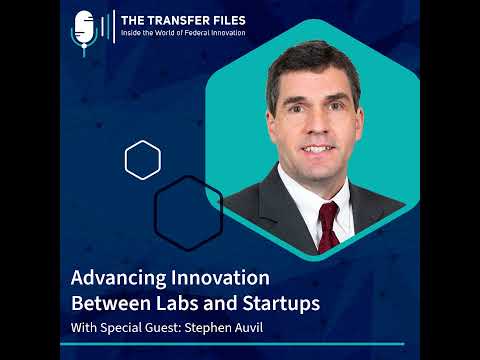
Stephen Veil: Federal labs can have a "dual mission," but culture and rules slow commercialization
Summary
Stephen Veil, TEDCO's chief federal engagement officer, says federal laboratories can both fulfill mission work and drive regional economic growth, but conflict-of-interest rules, conservative legal offices and funding gaps limit inventor engagement and slow commercial spinouts.
Stephen Veil, chief federal engagement officer at TEDCO, said federal laboratories could pursue a dual mission of carrying out government tasks while serving as engines of regional economic activity — if cultural and procedural barriers are addressed.
"There is a potential for Federal Labs to have a dual mission," Veil said, arguing that many federal technologies are "dual use" and could be adapted for commercial markets while still meeting lab missions. He told the Transfer Files podcast that three obstacles stand out: restrictive conflict-of-interest rules that limit innovators' engagement with startups; conservative general counsel offices inside labs; and persistent funding gaps to adapt mission-designed technologies for commercial use.
Veil, who has worked in university tech transfer and at TEDCO for 14 years, described how his own career moved from licensing roles at Johns Hopkins to incubator-focused work at UMBC and, later, to TEDCO's statewide investment and commercialization programs. He said university tech-transfer cultures have shifted over decades toward more venture development and that federal labs face a harder cultural lift.
"Doing a license is not the tech transfer. It's only part of the tech transfer," Veil said. "You also need to work with the innovators to help get what's in their head, what we just call know-how." He emphasized practical approaches TEDCO is testing to bridge the gap, such as placing industry-savvy "site miners" and entrepreneurs-in-residence into labs and partnering with agencies such as NIST to help inventors see alternative commercial applications for mission technologies.
Veil highlighted TEDCO's Maryland Innovation Initiative (MII), which funds technology validation in universities and invests in spinouts. He said MII created incentives for faculty disclosures, increased startup formation, and — based on TEDCO's analysis — helped Maryland move from roughly 30th to 8th in startups per research dollar. Veil said the model shows how targeted validation funding and early investments can shift outcomes.
He also described TEDCO programs aimed at federal labs: DefTech, focused on defense-lab commercialization and lab-company connections; and a Small Business Administration-funded FLIP program (Federal Lab Leveraging Innovation to Products) that targets life-science commercialization. Veil said TEDCO uses partnership-intermediary agreements and existing mechanisms (cooperative research and development agreements, OTAs) to open lab resources to Maryland companies.
On the human side, Veil recounted successful medical cases tied to public funding and tech transfer, including stem-cell work and therapies that he said materially improved patients' lives. "These are the things that kind of stick in my mind," he said, describing legislative outreach that showcases clinical impact.
For small businesses seeking lab access, Veil urged relationship-building and using intermediary organizations to navigate security, legal and administrative hurdles. "If you're intimidated with federal labs, find somebody that can hold your hand and walk you through it," he said. "It's your taxpayer dollars, so why not take advantage of it?"
The episode closed with host Andrea Nelson directing listeners to show notes and resources on federallabs.org and thanking FLC staff and the podcast production team. The Transfer Files podcast said it will return with more conversations on federal tech transfer.