Lifetime Citizen Portal Access — AI Briefings, Alerts & Unlimited Follows
PPPL showcases 'electromanufacturing' and sustainability research as lab expands beyond fusion
Loading...
Summary
Princeton Plasma Physics Laboratory researchers told a Federal Laboratory Consortium webinar that the lab is applying plasma science and computational modeling to microelectronics, hydrogen and electro-manufacturing projects aimed at decarbonizing industry, and invited industry collaborations and CRADAs.
Princeton Plasma Physics Laboratory researchers used a Federal Laboratory Consortium showcase to outline how the DOE national lab is extending its work beyond fusion into applied materials and sustainability sciences.
"Our lab's focus starts first of all with fusion energy," Emily Carter, a presenter from PPPL, said. "But in addition, there are new avenues of research related to building technologies for information and sustainability for the future." Carter described two new initiatives the lab calls electro-manufacturing and an aerosol-science program aimed at climate applications, and she said PPPL will leverage plasma and computational strengths to develop those efforts.
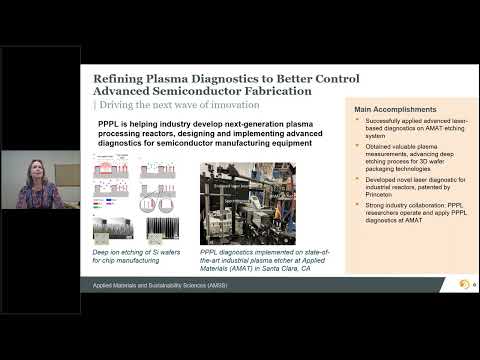
Carter said PPPL is partnering with industry and other national labs to apply plasma diagnostics and modeling to next-generation microelectronics. "We have cooperative research and development agreements with the main tool manufacturers, including Applied Materials as well as Lam Research, and a strategic partnership arrangement with Samsung," she said, adding that PPPL has installed novel laser diagnostics on an industrial plasma etcher to collect measurements that can optimize etching processes.
The presenter also outlined PPPL's role in DOE Energy Earthshot Research Centers. She described work using plasmas to convert methane and carbon dioxide into syngas and solid carbon products and noted a Hydrogen Shot research center led by Oak Ridge National Laboratory in which PPPL participates. Carter framed these activities as part of a broader goal to reduce the carbon intensity of chemical manufacturing and to substitute clean electricity for fossil-fuel-driven industrial heat.
Lab director Professor Steven Cowley opened the webinar by situating PPPL among DOE's 17 national labs and emphasizing the lab's computational and plasma-science capabilities. He and Carter repeatedly invited collaborations via CRADAs, strategic partnership projects and technical services agreements, and made contact information available for follow-up.
The session included audience questions about timelines and costs for fusion electricity. Carter acknowledged fusion is not yet cost-competitive with mature renewable technologies and said cost-constrained research is an active priority; she described realistic electricity contributions from fusion as more likely toward the middle of this century than within the coming decade.
The webinar closed with an invitation to contact partnerships@pppl.gov for collaboration inquiries and with a reminder that the Federal Laboratory Consortium can help connect potential partners.