Get Full Government Meeting Transcripts, Videos, & Alerts Forever!
Get email alerts on the Data Census Gov Release topic
No spam. Unsubscribe anytime.
U.S. Census Bureau rolls out December 2025 data.census.gov updates: unlocked filters, shareable custom table views and MDAT grouping
Summary
The U.S. Census Bureau on Thursday described the December 2025 release of data.census.gov that removes locked filters, saves flat-table customizations in the URL for easy sharing, adds an ACS table note and address-search widget, and expands microdata access tool grouping and usability.
Tyson Weister, a presenter with the U.S. Census Bureau, outlined the December 2025 release of data.census.gov and demonstrated a set of user-facing and backend changes intended to make the portal easier to navigate, to share customized table views, and to support future data expansions.
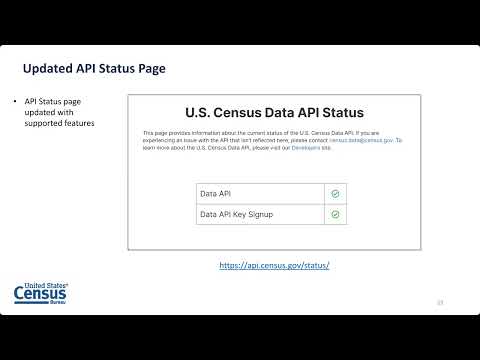
The changes announced include removing lock icons from filters so each selected filter shows an "x" for removal; new alphabetical (A–Z) and numeric (0–9) scroll bars for long filter lists; a reordered table toolbar that places common actions (download, cite, share) front and center; preservation of flat-table customizations in the page URL so shared links reproduce the same view; a new American Community Survey (ACS) 1-year table note giving guidance for time comparisons and cross-source comparisons; an address-search widget that can be embedded on other sites; enhancements to the microdata access tool (MDAT) including the ability to group geographies; and an updated API status page that shows supported features and key availability indicators.
"We have removed lock icons throughout the site," Weister said during the live demo, describing how every selected filter now includes an "x" so users can individually remove filters they no longer want. He demonstrated the change using a hierarchical table for housing value in Houston, where the demonstration showed three filters (housing value topic, Houston city geography and 2021) and a median home value of $236,700 in the 2021 ACS 1-year estimate.
Weister walked through both hierarchical and flat-table workflows. Hierarchical tables (used for many ACS and Decennial products) now present common output actions prominently; flat tables (used for larger or more complex datasets such as County Business Patterns) expose editing tools up front. He demonstrated using table ID CB2300CBP and said the full flat table initially contained 48,144 rows, which he narrowed to 9,000 and then to 1,165 rows through filter and pivot steps to find top states for employment in NAICS 21 (mining, core, oil and gas extraction). "The top 5 states for number of employees working in this sector are Texas, Louisiana, Oklahoma, Pennsylvania and Colorado," he said.
On downloads, Weister said the toolbar now contains a single "Download" button that groups Excel (presentation-ready), CSV and ZIP output options and explains the differences. "Yes, you absolutely can [download a table with filters applied] as long as you are choosing the Excel or CSV option," he said in response to an attendee question; ZIP will download the full dataset regardless of on-screen customizations. He demonstrated that Excel preserves the table’s presentation formatting while ZIP provides flat CSV files with geo IDs for machine use.
Weister also demonstrated new MDAT functionality. Using the ACS 5-year public use microdata sample (PUMS), he selected four PUMAs that make up Spokane County, created a custom group labeled "Spokane County," and showed a combined row reporting 3,459 active duty service members in the combined geography. He described other MDAT changes—search bars in geography panels, new messages and mobile compatibility—as targeted at advanced users who build custom microdata tables.
Asked about support for time-series downloads of ACS tables, Weister said there is not currently a general site feature that assembles multiple single-year ACS tables into a single multi-year time series; he pointed listeners to comparison-profile products that show two vintages of ACS 5-year estimates and encouraged use of the API or table lists on the ACS site for bulk access by table ID.
Looking ahead, Weister said short-term work includes an improved landing page (planned for February) and the long-term priority is migration to the cloud to support ongoing releases and reliability. He closed by directing users to release notes, recorded tutorials and training resources on census.gov/academy and provided contact emails for data questions and outreach.
The webinar concluded with a brief Q&A in which Census staff reiterated contact points for media and training requests and noted that slides and release notes would be posted for later review.