Get email alerts on the Data Access topic
No spam. Unsubscribe anytime.
Census tutorial shows how to compare urban and rural data on data.census.gov
Summary
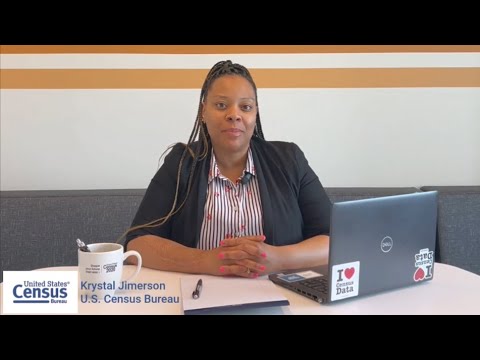
Crystal Jemmerson of the U.S. Census Bureau demonstrated how to use geographic components on data.census.gov to aggregate urban and rural portions of a state and view American Community Survey table S1901 to compare household income for Georgia’s urban and rural areas.
Crystal Jemmerson of the U.S. Census Bureau demonstrated how to use geographic components on data.census.gov to aggregate urban and rural portions of a larger geography and compare statistics such as household income. The tutorial used Georgia and table S1901 from the American Community Survey 2023 1-year estimates as an example.
Jemmerson opened the brief walkthrough by explaining that the Census Bureau does not itself redraw rural boundaries for every area but that users can sum the urban and rural portions of another geography — for example, a state or county — to produce aggregated rural and urban statistics. "While the Census Bureau does not necessarily define rural boundaries and publish data for rural areas by geography," she said, "we do have a tip to show you how you can get some statistics for aggregated rural and urban areas." (Crystal Jemmerson)
A presenter identified in the transcript as Jill then led viewers through the on-screen steps. She instructed users to go to data.census.gov, click Advanced Search, select State, and enable the option to "show geographic components." That lets a user check both the statewide geography and its "Georgia urban" and "Georgia rural" components to sum the state’s urban and rural populations without listing every urban area individually.
Jill narrowed the query by choosing the topic "Income and Poverty" and selected table S1901, titled "Income in the past 12 months, inflation adjusted dollars" from the American Community Survey 2023 1-year estimates. She scrolled the table to display median household income values for the state and for the selected urban and rural components shown on the screen; the tutorial notes that these figures are updated annually and may change as new estimates are released.
The presenters emphasized that the geographic-components method can be used at the county or national level as well. Jemmerson pointed viewers to a linked FAQ under the video for more detail and to an additional short video, "Are you an urban or rural area?" for guidance on determining whether a specific address lies in an urban area. She closed by directing viewers to census.gov/academy for further tutorials and inviting them to subscribe.
The video is a procedural how-to demonstrating data.census.gov features; it does not make policy recommendations or present new Census classifications. For users seeking the specific table shown in the demonstration, the presenters referenced table S1901 (American Community Survey 2023 1-year estimates) and the data.census.gov advanced search interface.
AI generated
The text on this page is AI generated. Summaries, highlights, analysis, and video transcripts are all produced from the original source material.
AI can make mistakes, so if you spot one, and we will fix it for everyone.
Note: the source content is unaltered by us. Any content source we link to, be it a video, an audio recording, or a document, is presented exactly as its publisher released it. That publisher is usually a government body, sometimes an individual official or another organisation.