Lifetime Citizen Portal Access — AI Briefings, Alerts & Unlimited Follows
Senator urges vote for GOP patient-directed accounts over Democrats' premium-credit approach
Loading...
Summary
On the Senate floor a senator urged colleagues to back a Republican plan that would place funds into patient health savings accounts so individuals can pay out-of-pocket costs, contrasting it with Democrats' proposal to extend enhanced premium tax credits to insurers; a vote was scheduled for the following day, he said.
A senator on the Senate floor urged colleagues to back a Republican alternative to Democrats' proposal for subsidizing coverage on the Obamacare exchanges, saying the GOP approach would put money directly into patients' hands rather than routing it to insurance companies.
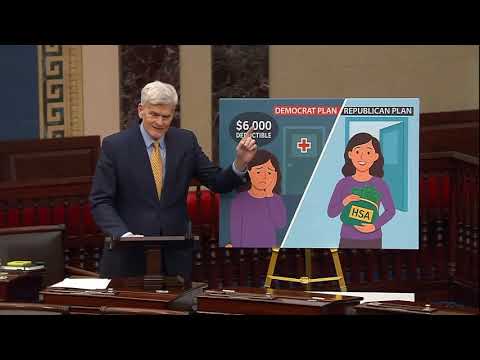
The senator framed the choice ahead of a vote he said was scheduled for the next day as two competing visions: Democrats would extend enhanced premium tax credits that flow through insurers, while Republicans would deposit funds into patient-directed accounts or health savings accounts that the patient could use for care. "Let's put the money in the purse, pocketbook, or wallet of the American citizen to give her money to pay for the out of pocket cost of an insurance company," he said.
The issue matters because the competing approaches affect who receives subsidy dollars and who makes coverage decisions. The senator identified the Republican measure as one he and "Senator Crapo, the finance chairman," proposed and referred to the Democratic option as a straight three-year reauthorization of enhanced premium tax credits on the exchanges.
On specifics, the senator said Democrats' approach would leave many people with a $6,000 deductible and contended insurers would take a portion for overhead and profit (he cited "20% for profit and overhead"). He described the Republican plan as placing roughly $5,000 into a patient's account in his example and allowing that money to be used directly for services such as doctor visits, dental care, prescriptions and eyeglasses. "A 100% of the money in there is used for the care she knows she needs," he said.
Using figures he said came from healthcare.gov for 2026, the senator offered a family example: a family of four at 500% of the federal poverty level (he estimated about $160,000 per year) could choose a bronze plan instead of silver and would receive $5,000 into the patient account, which he said would reduce that family's net deductible compared with the Democratic option. He characterized those numbers as illustrative of how the Republican plan would "relieve the stress" of high out-of-pocket costs.
The senator also alleged that the current system is "rife with fraud" and said the Democratic leader's proposed reauthorization would not address that fraud. He urged colleagues to take steps "to stop that fraud," and criticized Democrats for defending the existing structure, saying it produced profits for insurance companies.
He addressed concerns about abortion funding raised by opponents of the Republican approach by citing the Hyde Amendment, saying that the amendment — which he described as having been included on annual appropriations since the 1970s — prevents federal dollars from being spent on abortion. He presented that history as a reason the Republican plan would not permit taxpayer-funded abortions.
The senator concluded by urging the Senate to "give power to the patient, not profit to the insurance company," and yielded the floor. He named the Republican proposal as linked to himself and Senator Crapo; the transcript records no immediate floor response or roll-call result in the speech text.
Notes on sourcing and claims: the speech attributes the fraud allegations, the 20% insurer overhead figure, the $5,000 account amount and the family income estimate to the senator's statements on the floor; the transcript does not include corroborating evidence for those specific percentages or the fraud magnitude within the speech itself. The transcript identifies the speaker only by floor address; no personal name appears in the provided segments.