Get Full Government Meeting Transcripts, Videos, & Alerts Forever!
Get email alerts on the Housing And Economics topic
No spam. Unsubscribe anytime.
Planning commission reviews city fiscal-impact model and GIS housing memo; rezoning in northwest Denton approved
Summary
Commissioners heard a detailed walk-through of the city's 40-year fiscal-impact model and a GIS-based undeveloped-land study estimating potential housing capacity; they also approved a rezoning (Z25-025A) for ~5.4 acres in northwest Denton and granted two plat extensions.
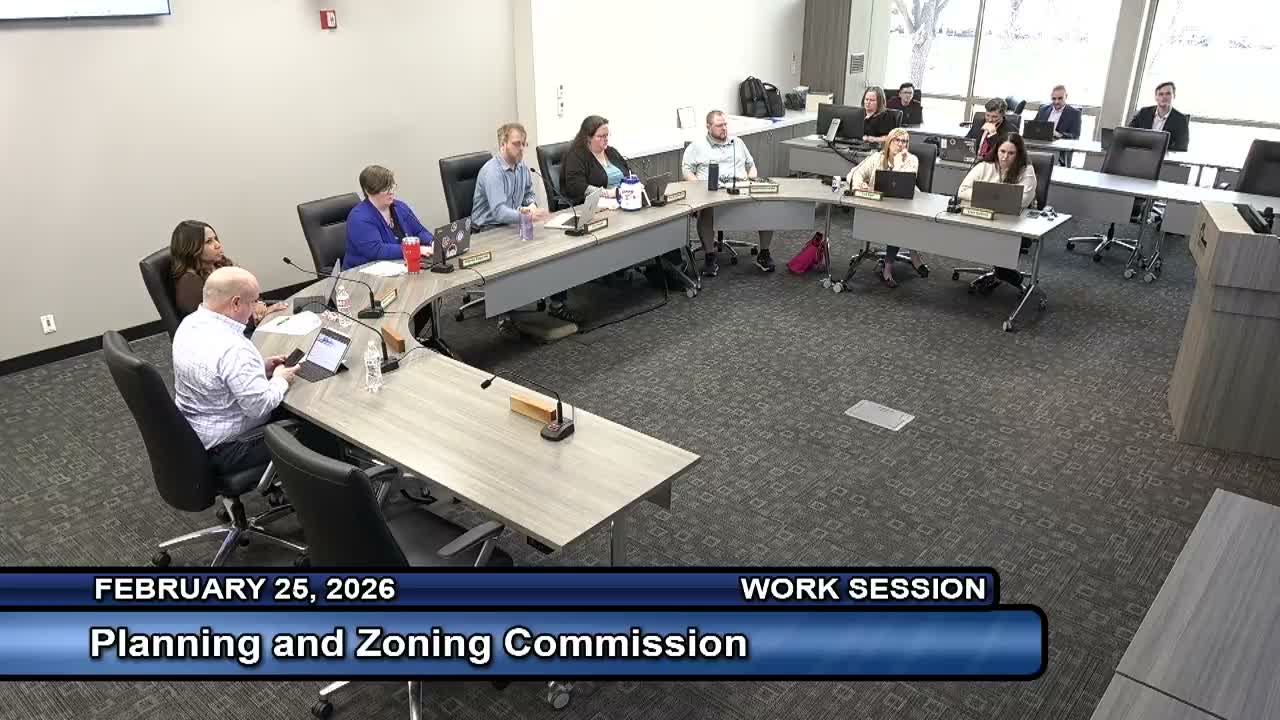
The Denton Planning and Zoning Commission on Feb. 25 spent considerable time on two staff briefings designed to give commissioners more context for land-use decisions: a detailed review of the city's fiscal-impact tool and a GIS-based undeveloped-land analysis that tabulates vacant acreage by zoning district.
Charlie Rosenthal, interim director of development services, described the fiscal-impact tool as one of 13 approval criteria adopted with the city's 2019 development code. The model runs at the parcel level to estimate general-fund revenues and costs over a 40-year horizon. Rosenthal said the tool uses parcel GIS, historical effective rates and assumptions about development to project future property values and fees. The model includes an annual growth/inflation factor of 2.4% and can be overridden in specific cases when staff and applicants provide credible alternative construction-value estimates.
Rosenthal emphasized the model's limits: it is tuned for single-site analysis and averages municipal costs per resident (fire, police, library), so density tends to lower per-resident costs; the model includes roadway maintenance costs within a 40-year frame but does not capture long-term reconstruction cycles (typically 50–55 years), meaning some replacement costs are not included in the standard run.
For housing context, a staff GIS analyst explained an undeveloped-land analysis that used the National Land Cover Dataset (NLCD) and recent satellite imagery to classify 30-meter raster cells as developed or undeveloped. The team's method reclassified NLCD categories, sampled four points per raster cell, and classified parcels as undeveloped if more than half the sampled points were marked undeveloped. Staff emphasized that the output represents theoretical capacity under zoning rules and does not guarantee development. Using typical multifamily densities (about 20 units per acre) on currently zoned MN/MR acres, staff presented a rough maximum of roughly 6,600 potential multifamily units on ~330 acres, and reported a CoStar regional vacancy rate of about 16.5% based on available market data.
Commissioners asked how the city handles complex, large-scale projects; Rosenthal said the city hires consultants (for example, AECOM) with costs typically reimbursed by developers under escrow agreements when projects exceed the model's capabilities. Commissioners also discussed whether staff from other departments should routinely attend P&Z hearings for technical questions; staff said they could bring specialists when asked in advance and recommended members submit questions by Monday of the meeting week so appropriate colleagues could attend.
Separately, the commission approved rezoning case Z25-025A (called Arcamima), by a 6-0 vote, to change roughly 5.4 acres from rural residential to general office along Barthold Road near I-35. Applicant representatives said the general office designation provides enhanced design standards appropriate for the city's northwest gateway; staff had recommended approval. The commission also granted requests to extend final-plat deadlines for Hickory Grove Phase 5 and Phase 6 to March 18, 2026, and approved routine consent items and minutes (all votes 6-0).
The presentations were intended to give commissioners better tools to weigh fiscal and long-range infrastructure implications when reviewing future development proposals.