Get Full Government Meeting Transcripts, Videos, & Alerts Forever!
Get email alerts on the Zoning Commercial Code topic
No spam. Unsubscribe anytime.
Corte Madera planning commission studies commercial code modernization, seeks business and resident input
Summary
At a March 24 study session, the Corte Madera Planning Commission heard staff and consultant recommendations to simplify commercial use categories, allow outdoor commercial and temporary uses, and update parking rules. Staff reported 158 survey responses and will return this summer/fall with draft zoning amendments; no formal action was taken.
The Corte Madera Planning Commission convened on March 24 for a study session on a commercial code modernization project aimed at simplifying outdated land-use categories, adding explicit rules for temporary and outdoor commercial uses, and updating parking requirements.
Staff and consultant Martha Miller told the commission the effort is intended to create “a more flexible and user friendly regulatory framework that reflects contemporary business types and development practices.” Miller said the work will cover four commercial zoning districts and the town’s single mixed-use district and will not produce action tonight but will return with draft amendments in summer or fall.
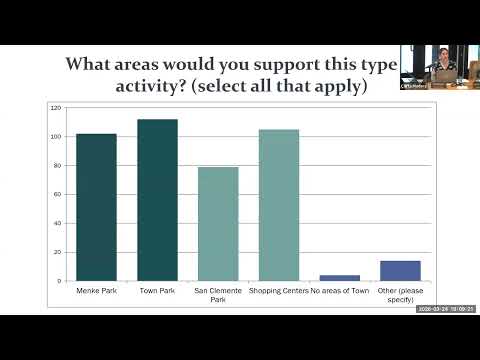
The presentation summarized outreach and research behind the proposals. A month-long survey completed by 158 people and stakeholder interviews showed residents ranked aesthetics, traffic congestion/parking and noise as the top issues they want zoning to address. “A strong majority” of survey respondents supported allowing food and coffee trucks in commercial areas and parks, the consultant said, and there was broad support for limited outdoor business uses such as farmer’s market stalls, outdoor seating and fitness classes.
Miller recommended several principal changes: define and consolidate more than 300 currently listed land uses into broader, clearer categories; add explicit allowances and standards for outdoor accessory uses (hours, screening, noise controls and thresholds that avoid triggering additional parking requirements); introduce a temporary-use chapter for private property that would distinguish low-impact allowed events, staff-level temporary permits, and conditional-use permits for recurring or larger activities; and revise parking standards to reduce and standardize minimums and create a formal process for parking reductions.
Commissioners and staff pressed for clarifications. Commissioner Valerie asked whether land-use categories or districts would be converted to mixed-use; staff said the four commercial districts and the MX-1 district would remain but some regulations would apply across both. Commissioners asked for clearer thresholds for minor expansions that would not trigger new parking calculations and suggested separating quick parking-management fixes (time limits, enforcement) from permanent reductions backed by a utilization study.
Members of the public generally supported the project’s flexibility. Tim Weed, who said he is pursuing adaptive reuse of the former Holy Innocents Episcopal Church at 2 Tamalpais Drive, described the building as “an extraordinary aesthetic and acoustic space” and urged rules that would allow a cafe and performance uses. Don Dickerson of Fitness SF requested broader language to include outdoor gyms and equipment, noting that outdoor programming “was such a huge life-saving thing” during the pandemic and residents still value outdoor fitness options.
Some residents urged caution. Online commenter Susie Beatty applauded creativity but warned against over-commercializing parks and urged strict regulation of food trucks to avoid harming brick-and-mortar businesses. Angela Foster, general manager of Town Center Corte Madera, told commissioners that parking rules directly affect leasing and urged the code to reflect current travel patterns, including rideshare and biking.
Staff outlined next steps: continued outreach and drafting of code language by the consultant, an opportunity for commissioners to review an outline or draft before formal hearings, and one or two planning commission hearings in summer/fall before the town council takes up the amendments (including the council’s required two readings; code changes would take effect about 30 days after adoption). No motions or formal votes were taken at the session.
Commissioners also used the meeting to note related town business: the town council unanimously approved a tobacco and nicotine ordinance and staff said landscaping work at Menke Park and updates to traffic and park impact fees are underway.
The commission closed the study-session item after receiving public comment and indicated staff will return with more detailed materials for review.