Get Full Government Meeting Transcripts, Videos, & Alerts Forever!
Get email alerts on the Evidence Admissibility topic
No spam. Unsubscribe anytime.
Alabama Supreme Court Hears Arguments Over Alleged Forged Discovery and $2.25M Emotional-Damages Award
Summary
In oral argument in Envoy Air Inc. v. Jada Cray, attorneys disputed whether an unauthenticated interrogatory answer attributed to Envoy was admissible after a special master found a forged attestation and whether a $2,250,000 emotional-damages award should be remitted; the court took the case under submission.
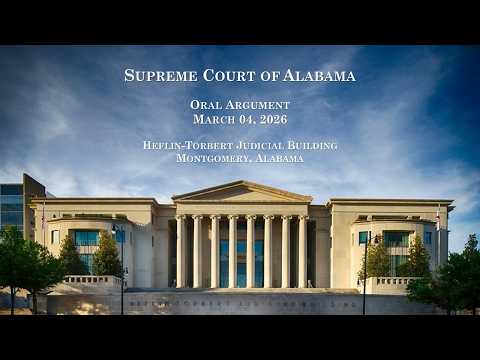
The Supreme Court of Alabama heard argument in Envoy Air Incorporated v. Jada Cray (SC20250022), an appeal from the Mobile Circuit Court, in which defense counsel argued a forged or improperly verified interrogatory answer was wrongly admitted at trial and that a $2.25 million emotional-damages award should be reduced.
Appellant's counsel Forrest Latta told the court the litigation began as a workers'compensation dispute and shifted when an interrogatory response contained an incorrect statement that the employee "voluntarily resigned." Latta said a later attestation page purportedly signed for Envoy was determined by a special master to be a forgery and therefore "was not evidence" and "was not imputable to Envoy." He argued the discovery response did not meet authentication requirements and was highly prejudicial to his client. "It was not evidence," Latta told the court when explaining why the interrogatory answer should have been excluded.
The bench pressed whether the special master's finding of forgery had been adopted by the trial court and whether the authenticity question was for the judge or a jury. Latta said the trial court adopted the special master's findings of fact in a post-trial order and that the admission of the discovery response, without an opportunity to present Envoy's full backstory, improperly prejudiced the defense.
Appellee counsel James Daley countered that the record did not support Latta's account of the trial court's handling and framed the matter as one involving sanctions and the court's inherent authority to preserve the integrity of proceedings. Daley told the court that the trial centered on competing narratives about who forged a return-to-work slip: "If it's Jada, we lose. If it's Miss Atkinson, we win," he said, describing the jury's focus at trial. Daley argued the evidence presented at trial supported the jury's findings and said an unsigned interrogatory answer could function, in the sanction context, as evidence of pretext.
Justices also questioned whether the wrongful-termination claim required proof of "sole causation," i.e., that no other legitimate decisionmakers were involved, and probed the record for direct evidence that station manager Bridget Atkinson was the decisionmaker rather than HR personnel in Texas. Latta maintained there was documentary evidence showing HR involvement and that multiple decisionmakers undercut the plaintiff's sole-causation claim.
The attorneys disputed procedural specifics: whether the judge initially excluded the contested material and later admitted it, whether Envoy was permitted to present corrective evidence without impinging a parallel proceeding against counsel, and whether Envoy had made an adequate offer of proof. Daley described a curative instruction drawn during closing that the trial judge reviewed with counsel and then read to the jury; Latta said a curative instruction could not erase the prejudice that had occurred.
The justices also asked about remittitur of the emotional-harm award. Latta urged heightened scrutiny for non-physical-injury awards and suggested, citing cases in his brief, that a substantially lower figure (he mentioned $50,000 as an upper-end comparator from on-point decisions) would be appropriate if the court found remittitur necessary. Daley defended the award as supported by testimony that the plaintiff experienced stigma, paranoia and employment difficulties; he cited precedent the court should consider in evaluating the reasonableness of the amount.
After argument and brief rebuttal, the bench announced it would take the case under submission. No decision was announced at the oral-argument session.
What happens next: The Supreme Court will issue a written opinion resolving whether the interrogatory response was admissible and whether the damages award must be remitted; the court took the case under submission at the end of oral argument.