Lifetime Citizen Portal Access — AI Briefings, Alerts & Unlimited Follows
Port Canaveral hears pitch for small‑scale LNG plant on 50‑acre Barge Canal parcel
Loading...
Summary
Port Canaveral staff and outside developers presented an unsolicited proposal to buy or lease a roughly 50‑acre parcel on the Barge Canal for a small‑scale LNG facility, outlining valuation, permitting hurdles under Brevard County's comprehensive plan and mitigation plans for safety, noise and traffic; no vote was taken.
At an afternoon workshop, Port Canaveral Authority staff and outside developers laid out an unsolicited proposal to buy or lease roughly 50 acres along the Barge Canal for a small‑scale liquefied natural gas (LNG) facility, then answered commissioners' questions about valuation, permitting and community impacts.
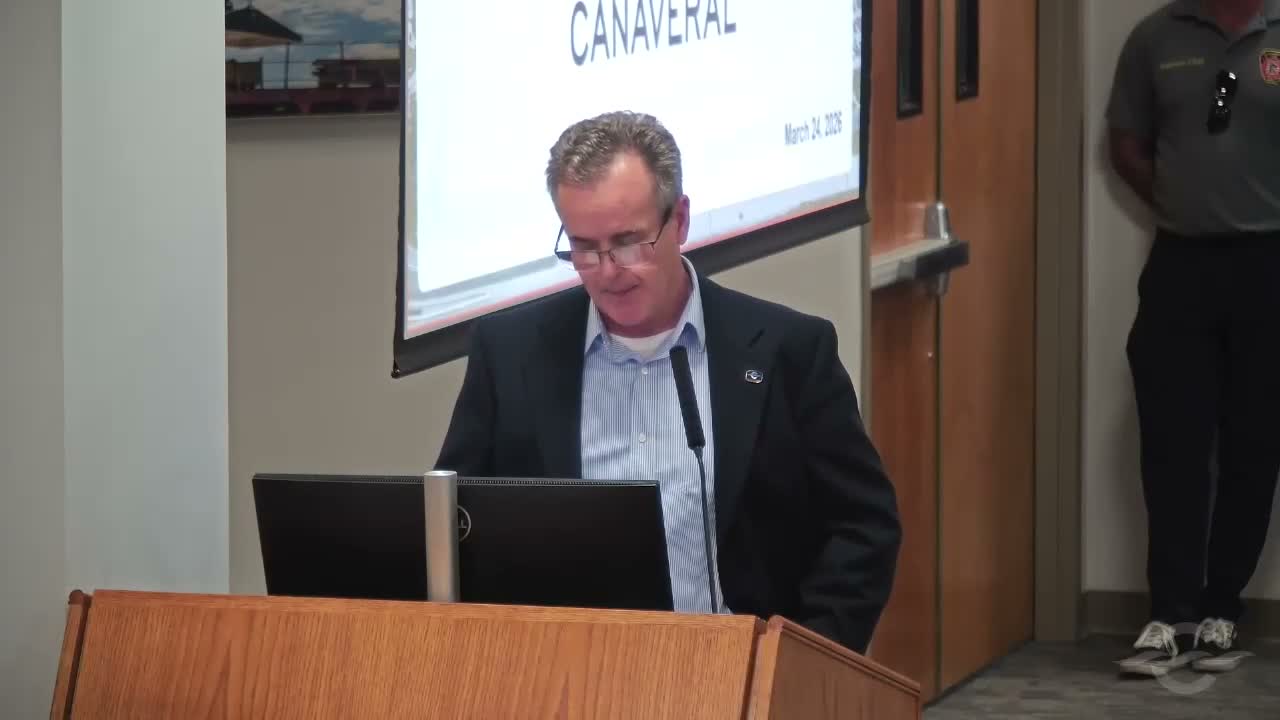
The presentation, led by the port's general counsel and Real Estate Director Mark Milositz and followed by proponents from Berkshire Hathaway Energy and consultant Alan Shepherd of HDR, focused on whether the parcel is strategically valuable to the port and whether an LNG use would serve port customers. Mark Milositz said a recent appraisal placed the site's value at $11.4 million (about $238,000 per acre) after subtracting roughly $7.7 million to account for mitigation of about 23 acres of wetlands.
Brevard County's planning director, Billy Prasad, told the board that if title were transferred away from the port the proposal would face substantial local and state review. "Brevard County shall not permit heavy industrial development along the Barge Canal," he said, identifying that policy in the county's comprehensive plan (transportation element policy 5.4) as a threshold barrier: a privately initiated text amendment, a small‑scale comprehensive plan amendment, rezoning to heavy industrial and a conditional use permit would all be required and each step would carry public hearings and a state review period.
Roger Williams, representing the Canaveral LNG partnership, said the proposers engaged cruise and aerospace customers and that locating a small‑scale facility on the Barge Canal would be the most viable local solution to supply LNG to those customers. "If we can agree that the need for LNG in Canaveral is both large and critical, it really comes down to whether there's a realistic viable alternative to get LNG fuel to the industries that so desperately need it," Williams said. He and HDR's Alan Shepherd described a conceptual layout that would include phased liquefaction trains, barging access via a turning basin, and storage tanks roughly 60 feet tall.
Alan Shepherd, who leads HDR's LNG practice, described industry safety and permitting requirements that would apply. "The bottom line is we cannot affect anybody off property," he said, summarizing the requirement in PHMSA, Coast Guard and NFPA codes to model spill vapor and thermal radiation zones and to design containment that prevents off‑site impacts. Shepherd said the facility would use closed‑loop cooling (not drawing canal water), would pursue required air permits and would design to meet local noise limits.
Port staff and commissioners pressed on tradeoffs. Port Real Estate Director Milositz and the port's CEO (referred to in the meeting as Captain Murray) noted that much of the county's listed acreage includes submerged land and that the usable upland is smaller; Milositz said the central vegetated portion of the appraiser's mapped parcel is roughly 56 acres but the parcel commonly discussed at the workshop is about 50 acres and would require a new survey to define legal boundaries. The CEO cautioned that the port's waterfront interface is its most valuable asset and warned that giving up 2,100–3,000 feet of waterfront would be a significant loss for berth capacity and future maritime operations.
Commissioners also raised neighborhood concerns. One commissioner who visited a Jacksonville LNG facility said he observed odor and noise there and asked whether this proposed plant would run on on‑site generators or grid power. Williams said truck deliveries would serve aerospace customers initially with one to two purpose‑built barges expected to operate from the canal; he said the project could reduce truck miles if customers later invest in barge infrastructure. Shepherd said noise mitigation measures (walls, enclosures, equipment enclosures and acoustical treatments) would be part of the design and that the facility would be modelled to meet a 60 dBA limit at property lines where local ordinances require it.
The presenters repeatedly noted that the proposal faces substantial regulatory and public review and that the port would have to decide if the parcel is strategic enough to pursue sale or long‑term lease. General Counsel walked commissioners through the port's internal steps if staff were authorized to negotiate: staff would be authorized to negotiate LOI terms, the board would review and authorize progression to purchase & sale and lease documents, legal descriptions and notices would be prepared, and there would be due diligence and closing; an additional hearing and notice would be required if a lease exceeded 30 years.
No vote was taken at the workshop. One commissioner signaled intent to bring a motion at the regular meeting the next day to "put this thing to bed," but the workshop concluded with the board still weighing strategic value, community impacts and the multi‑step permitting process that would follow any title transfer.
Next procedural steps noted in the workshop: the port could authorize staff to negotiate LOI terms and the city/county and state review processes described by Brevard County would follow if title left the port's control. Public comment on the topic was not permitted at the workshop but is scheduled for the port's regular business meeting the following day.