Get Full Government Meeting Transcripts, Videos, & Alerts Forever!
Get email alerts on the Environment Waters topic
No spam. Unsubscribe anytime.
Dover council awards $149,000 contract for mechanical milfoil removal at Willand Pond after heated debate
Summary
After hours of public comment and technical testimony, the Dover City Council voted to award a $149,000 contract to C & D Underwater Maintenance to pursue diver-assisted suction harvesting (DASH) and related mechanical work at Willand Pond, rejecting the staff‑endorsed ProcellaCOR‑first plan.
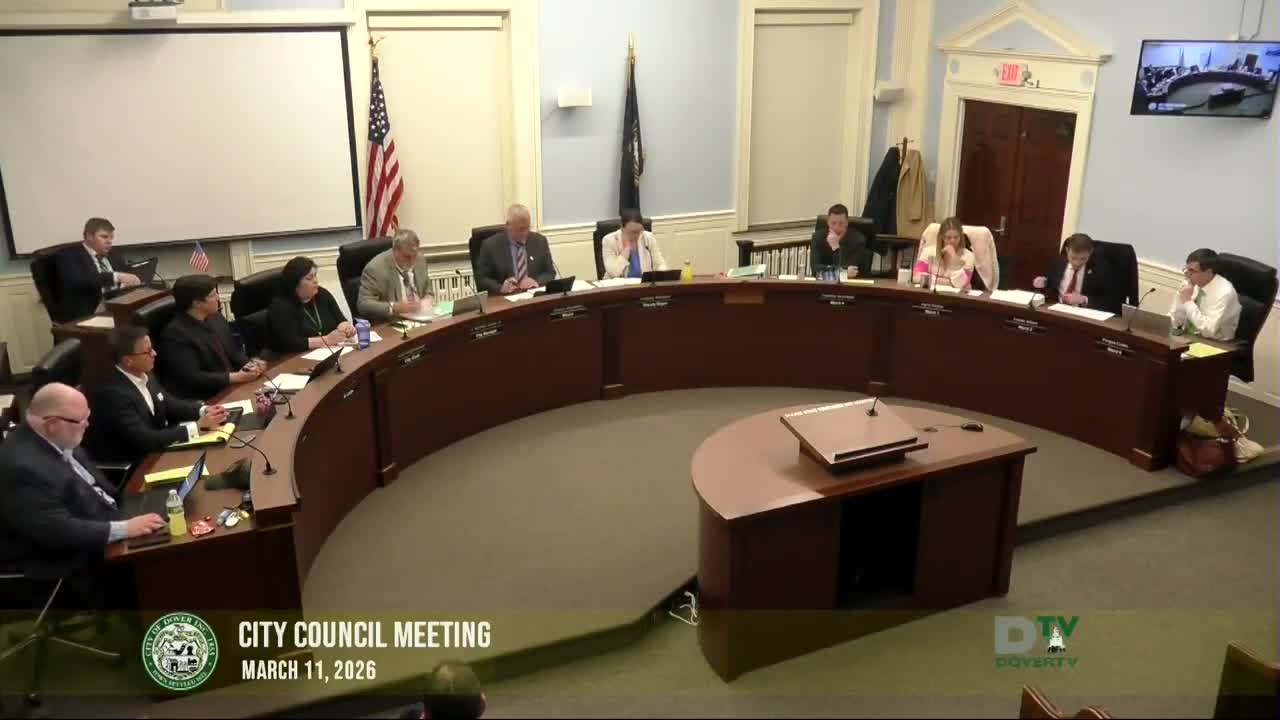
The Dover City Council voted to approve a twice‑amended resolution on March 11, awarding a purchase order of $149,000 to C & D Underwater Maintenance to address a 28‑acre milfoil infestation in Willand Pond. The decision followed more than three hours of public comment and technical testimony, and ended with a final 7–2 vote to approve the amended contract and authorize the city manager to find the funds to pay for it.
Residents and conservation‑commission members filled the council chamber and urged mechanical removal rather than herbicide treatments. “We picked up just over a ton of litter,” said Deborah Clough of Don't Trash Dover during the public forum, asking the city to support community conservation efforts. Several speakers warned about the potential for long‑term contamination if herbicides were used; Cynthia Walter told the council an herbicide application could create “60,000 pounds of dead material” that would accelerate low‑oxygen events and feed cyanobacteria blooms.
Staff presented the RFP results and two distinct cost profiles. Stahl Holdings offered a three‑year package (including an initial ProcellaCOR treatment and follow‑up) priced at $47,455 for three years (with a one‑year alternative of $28,760). C & D Underwater Maintenance proposed a primarily mechanical approach — 30 days of diver‑assisted suction harvesting (DASH) with eco‑harvester support — for $149,000, plus daily rates if additional days were needed. City staff said New Hampshire Department of Environmental Services (DES) had recommended an integrated plan that begins with ProcellaCOR followed by DASH in subsequent seasons.
Georgia Bunnell, exotic species program coordinator at New Hampshire DES, told the council that DES typically approves permits and conducts residue testing after herbicide treatments and that the state’s recommendation was intended to reduce the infestation to a manageable scale before mechanical follow‑up. “Whenever we have a contractor conduct an herbicide treatment … there's a lot of testing that's done before and after treatment,” Bunnell said, describing post‑treatment residue checks and monitoring of nearby wells.
Councilors and speakers disputed whether ProcellaCOR is a PFAS compound and debated tradeoffs between short‑term cost, long‑term risk and feasibility. Conservation‑commission members and several residents argued mechanical removal better aligns with the council’s prior commitment to least‑toxic methods; others, including staff and DES, warned that a mechanical‑only approach may be costlier and less predictable at the current scale.
The council first voted 5–4 to amend the resolution to select the DASH/eco‑harvester option (option A from C & D) instead of the staff‑recommended DES plan. The council then amended the resolution to authorize the purchasing agent to issue a purchase order to C & D Underwater Maintenance for $149,000 and directed the city manager to reallocate funds as needed; that amendment passed 8–1. The final amended resolution passed 7–2.
The council and staff said the award is intended to start work this season and that the city will pursue a multi‑year maintenance plan and budget in subsequent budget cycles to avoid repeating the current large‑scale intervention. City Manager (name provided in meeting materials) told the council the likely source of funds would be reallocation within departmental maintenance budgets or contingency and that future maintenance must be budgeted to avoid repeated emergency expenditures.
No single approach guaranteed complete eradication; councilors urged careful oversight of vendor certifications and performance. DES staff noted that DASH contractors must be certified in New Hampshire and that eco‑harvester use has not been widely used in the state and may require additional reviews. The council said it expects staff to enforce contract terms, verify certifications, and return to the council if the vendor cannot meet the obligations stated in its proposal.
Next steps: staff will finalize the purchase order with C & D Underwater Maintenance, proceed with vendor certification checks and permitting, and return to the council or integrate costs into the FY27 budget as part of a multi‑year maintenance plan.