Lifetime Citizen Portal Access — AI Briefings, Alerts & Unlimited Follows
Churchill County planning panel denies GP Global requests for multiple railroad‑corridor signs
Loading...
Summary
On April 8, 2026 the Churchill County Planning Commission denied two variance requests from GP Global LLC to install multiple large signs along railroad right‑of‑way parcels, rejecting one application 3‑2 and the other 5‑0 after staff and neighbors said the variance findings were not met.
FALLON, Nev. — The Churchill County Planning Commission on April 8 denied two separate variance requests from GP Global LLC seeking to install multiple large signs along railroad right‑of‑way parcels, saying staff could not make the four required findings for a variance.
The more contested request — VAR26‑1, for five 140‑square‑foot signs on a mile‑long railroad corridor parcel — failed on a 3‑2 vote after commissioners and members of the public questioned whether the owner had shown the “extraordinary or exceptional” hardship Nevada law requires. A second, nearby variance (VAR26‑2) for two signs on a shorter parcel was denied unanimously (5‑0).
Why it matters: The cases test how the county’s per‑parcel signage limits apply to linear railroad parcels. GP Global argued the parcels’ narrow, mile‑long shape makes a single permitted sign look “isolated” and that multiple evenly spaced signs would be more orderly; staff and several residents said the code’s per‑parcel square‑foot limit prevents that result without a change to county ordinance.
Dan Callan, Churchill County planning staff, told the commission that staff was “unable to make all of these findings, and therefore recommends a denial.” He said the parcel configuration did not rise to the kind of topographical or practical hardship normally required for a variance and that allowing the variance would create a different standard for similarly zoned properties.
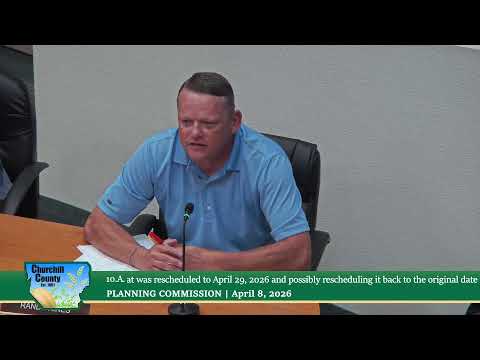
Applicant George Pomeroy, representing GP Global Outdoor Advertising, acknowledged the unusual geometry but argued the code’s per‑parcel limit produces an unintended effect on a long, narrow railroad parcel. “My position is that on a parcel like this, consistency over distance maintains visual quality better than a single isolated sign,” he said, arguing that five smaller signs would be “intentional and orderly and not random and scattered.”
Opposition from residents and counsel framed the request as economic rather than evidencing the deprivation of all beneficial uses. John Gezlin, an attorney representing nearby residents, cited Nevada case law and told the commission the state Supreme Court requires property owners to demonstrate an exceptional hardship before a variance can be granted: “The owner has not provided any evidence that there was an exceptional or practical difficulty or an exceptional or undue hardship,” he said, referencing Enterprise Citizens Action Committee v. Clark County Board, 112 Nev. 649.
Staff and the public also noted state and federal review steps for billboards and a response from the Nevada Department of Transportation was included in the hearing packet. County staff said the applicant had secured railroad concurrence for proposed placements but that NDOT’s requirements and county code limits remain separate constraints.
Technical detail: Each proposed sign would be 140 square feet. The county code limits total sign area per parcel to 140 square feet; allowing five would total 700 square feet unless the code is amended or a variance is granted. For VAR26‑1 staff recommended denial because they concluded the parcel was not shown to be characterized by the exceptional narrowness or other conditions that justify a variance and that allowing the request would be detrimental to neighboring property rights.
Outcome and next steps: VAR26‑1 was denied 3‑2; VAR26‑2 was denied 5‑0. The commission noted the 10‑day appeal period to the Board of County Commissioners for applicants wishing to appeal.
The commission moved on to other items after the votes; the meeting adjourned at 6:48 p.m.