Lifetime Citizen Portal Access — AI Briefings, Alerts & Unlimited Follows
APS official details vegetation clearing, sensor network and PSPS planning for Yavapai County
Loading...
Summary
Frank Sanders, APS Northern Division Director, told the Yavapai County Board on April 1 that APS has expanded fire-mitigation work — including vegetation clearing, pole wrapping and data-driven PSPS planning that now covers “over a 100” circuits — and described customer communications and preparedness steps.
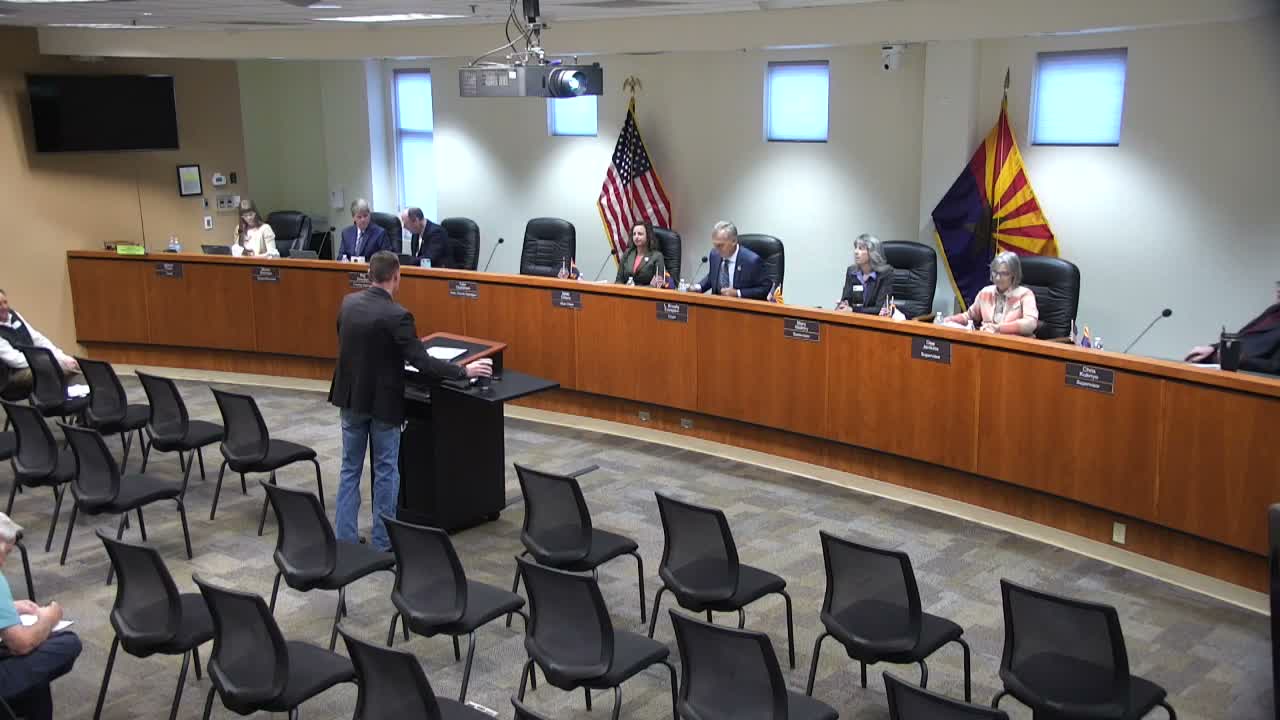
Frank Sanders, Northern Division Director for APS, briefed the Yavapai County Board on April 1 on the utility’s expanding wildfire-mitigation program, describing vegetation clearing, pole protections, new monitoring tools and plans for public-safety power shutoffs (PSPS).
“When you flip the switch, we want the lights to be on,” Sanders said, framing reliability as a core mission but adding that customer and community safety takes priority as wildfire risk grows. He identified vegetation management of rights-of-way, defensible space around poles and equipment upgrades as primary prevention steps.
Sanders said APS clears about a 10-foot radius around poles fitted with equipment that can spark, a practice called DSAP, and has instituted mesh wrapping on wood poles where crews cannot reach with bucket trucks to dissipate heat. He also said APS has replaced traditional fusing in many fire-mitigation areas with expulsion‑limiting fuses to reduce sparking.
The utility began pre‑fire-season inspections on Jan. 1, Sanders said, and crews patrol every feeder designated for fire mitigation. Work identified during those patrols is slated for repair with a May 1 completion target for pre‑season fixes.
“A lot of the things we do around fire mitigation is prevention,” Sanders said. “We make sure that those areas are clear.”
Sanders described technology investments that feed operational decisions. APS uses a platform called Technosilva to combine weather, topography, vegetation health and historical data to model fire risk; the utility has also deployed more than 100 weather stations and about 32 AI‑enabled pan‑tilt‑zoom cameras that can detect heat and smoke and filter out non‑fire signals.
He cited two on‑the‑ground examples: APS’s cameras triangulated the Brady fire last February, and in Camp Verde, sensors alerted emergency services “7 to 10 minutes” before the first 9‑1‑1 call, according to Sanders.
Sanders said APS has installed thousands of fault indicators to help crews locate problems quickly and has adopted a five‑level preparedness framework; the North region was at level 2 on April 1. At preparedness level 3 and higher the utility shifts to a non‑reclosing strategy—reclosers are set not to attempt automatic reclosing after a fault—and crews perform visual inspections before reenergizing circuits.
On the PSPS program, Sanders said this is APS’s third year running planned outages as a risk‑reduction tool. ‘‘The first year we had 13 circuits,’’ he said; ‘‘last year we had somewhere in the thirties, and this year we have over a 100.’’ Sanders emphasized that automated models inform recommendations but that final decisions involve staff judgment and coordination with emergency‑management partners and elected officials. When a PSPS is likely, APS notifies partners (he mentioned “Ashley and Phil”), then communicates with affected customers via email, text, social media and phone.
Sanders described operational practices during a PSPS: patrols can expand to ‘‘30, 40, or 50’’ personnel for visual line inspections, and when restoring power APS stages reenergization to avoid cold‑load pickup that can trip the system. He said customers who rely on medical devices can register with APS and with county emergency management to help prioritize service and response.
Board members welcomed the briefing. Supervisor Mallory said a recent local outage near Prescott Valley was restored within the hour and praised APS’s messaging and customer service: “You guys are awesome. I love the messaging and appreciate … you folks, you are top notch on customer service.”
Supervisor Kuchen asked whether APS provides a downloadable personal preparedness checklist and how to protect electronics from surge when power returns. Sanders pointed participants to APS’s customer resources (aps.com/psps) and advised consulting licensed electrical contractors for permanent generator installations, while noting staged restores should limit surge risk.
Supervisor Jenkins praised APS’s improved communications and reliability, saying he had benefitted from direct outreach during past outages.
The board thanked Sanders and adjourned; it said it would reconvene for its regularly scheduled 9:00 a.m. meeting.