Get Full Government Meeting Transcripts, Videos, & Alerts Forever!
Get email alerts on the State Equity topic
No spam. Unsubscribe anytime.
Lawmakers probe cost and timing of a 5%–25% state equity stake in Alaska LNG
Summary
The committee discussed state equity options for the Alaska LNG project: Department modeling shows a 5% stake would cost about $885 million (nominal) up front with positive cash flow later; members sought detail on financing triggers, cost‑overrun exposure and whether legislative appropriation would be required.
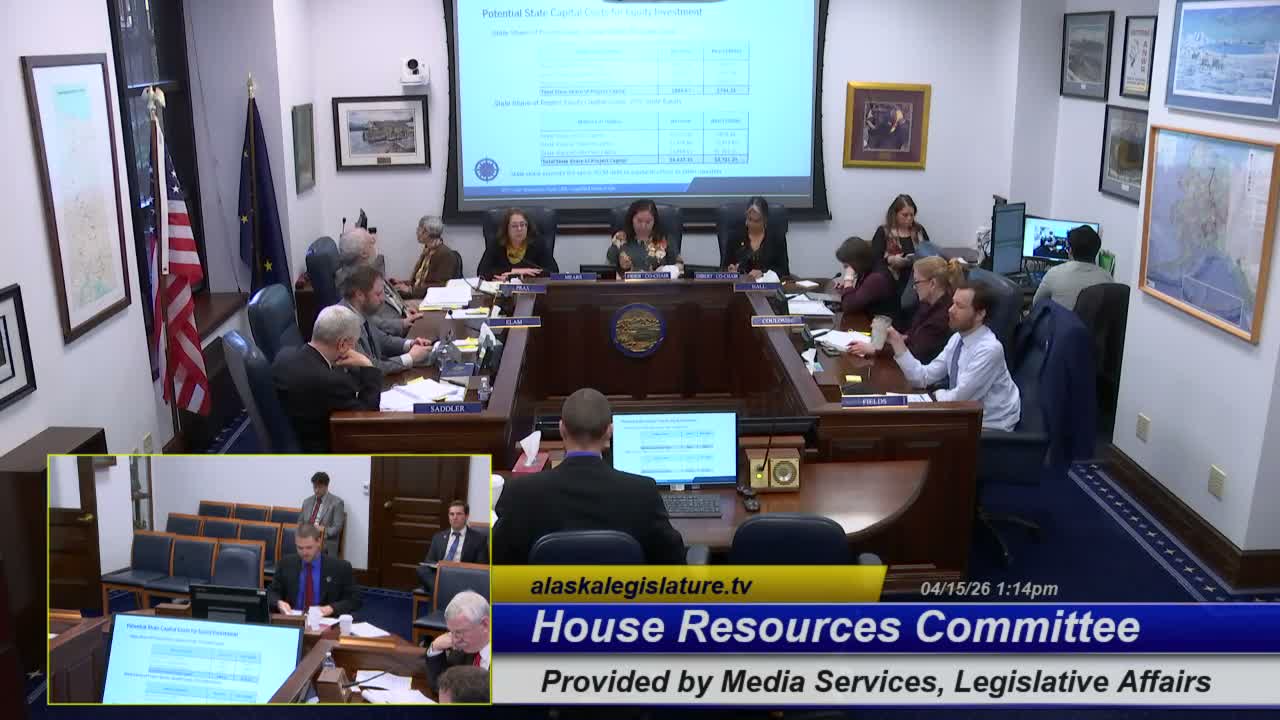
Juneau — Committee members pressed state and project officials on April 15 about what it would mean for Alaska to take an ownership stake in the Alaska LNG project, including the near‑term cash outlays, payback timing and who bears cost‑overrun risk.
Dan Stickel, chief economist at the Department of Revenue, said the department modeled two illustrative ownership levels. “For a 5% equity share, the state would need to lay out about $885,000,000,” Stickel said; a 25% share would require roughly $4.4 billion under the department’s baseline $46.2 billion capital assumption. The department’s tables assume a roughly 70/30 debt/equity financing structure and show that positive net cash flow to the state appears within the first decade of full production in the modeling.
Risk and contract design: lawmakers asked how cost overruns and future capital increases would affect an Alaska equity holder. Stickel said investors generally bear overruns; if the state takes equity it would share that risk unless the contract allocated protections. Representative Mears asked whether contracts could be written to protect the state from escalating obligations; Stickel responded that contract language could be drafted, but an investor that takes an equity share typically participates in upside and downside.
Preemption, timing and legislative approval: Matt Kissinger of AGDC, on the line, explained the practical trigger for a state decision. AGDC (and its 8 Star vehicle) will divest equity in subprojects to raise capital; each equity raise gives the state a preemption right and a six‑month window after the final investment decision (FID) to decide whether to exercise that right. Kissinger said appropriations would be required if the state used direct funding from the legislature; other financing routes, such as revenue bonds or alternative vehicles, were being explored.
Federal credits and financing assumptions: committee members asked whether federal carbon‑sequestration tax credits (IRC §45Q) and other offsets were included in modeling. Kissinger and department analysts said the model includes 45Q credits where sequestration qualifies and estimated those credits could be material — Kissinger referenced an illustrative $85/ton valuation that, in the consultants’ numbers, amounts to roughly $500 million per year in early years, reducing federal tax receipts under the scenario used.
Committee requests and next steps: members asked for more granular breakouts — exact payback dates, sensitivity to higher CapEx, phased equity options (investing only in pipeline vs the liquefaction plant), and clarity on whether municipalities or other state entities could participate indirectly. Department and AGDC officials agreed to provide follow‑up detail to the committee.
What was not decided: the committee took no vote on state participation or HB 381 at the April 15 hearing. Any state equity investment that requires appropriation would need legislative approval; AGDC also is studying revenue‑bond and other financing options that would not be backed by the state’s full faith and credit.
Quotable: Stickel: “For a 5% equity share, the state would need to lay out about $885,000,000.” Kissinger: “Every time that that happens… we have the right to preempt it. Starting with that commitment… we then have six months to determine whether we wanna preempt that and back into it or not.”