Get Full Government Meeting Transcripts, Videos, & Alerts Forever!
Get email alerts on the Budget topic
No spam. Unsubscribe anytime.
State Parks reviews post‑session budget outlook, sees small revenue gains but continued constraints
Summary
Agency staff told commissioners revenue is tracking slightly above projections and capital work continues, but several budget pressures and future biennium reductions mean staff will prioritize maintenance and shovel‑ready projects while pursuing targeted grants and legislative outreach.
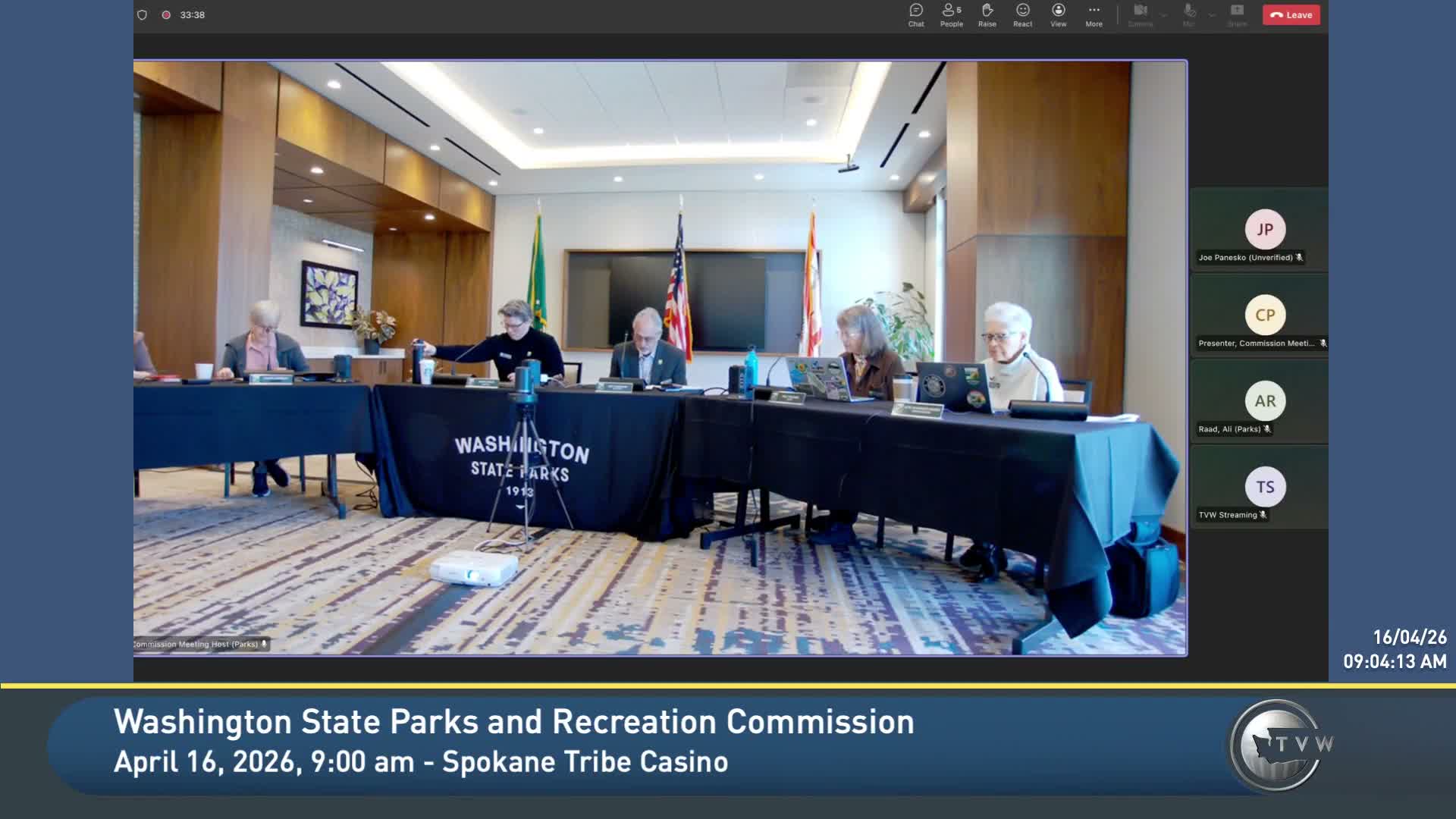
At the Washington State Parks and Recreation Commission work session on April 16 in Spokane, agency leaders gave a post‑legislative and budget briefing that framed this biennium as one of cautious optimism amid longer‑term funding uncertainty.
Brian Considine, the agencyexternal and legislative relations director, summarized outcomes from the recent legislative session, saying the session ended March 12 and that a small number of agency request bills passed while others did not. He noted a few wins for the agencyincluding a narrowly tailored winter recreation bill updating ski‑lift inspection terminology (bill 2272) and a tourism assessment bill that passed with an amendment adding Department of Commerce oversight. He said other agency proposals, notably snowmobile registration fee increases, did not clear both chambers this session but left “movement” and bipartisan committee support that staff may reintroduce in future sessions.
"Session ended on March 12," Considine said, adding that some bills that failed may be revived next session after further outreach and district education.
Laura Holmes, the business support services director, reviewed financial results through February and the agencyoperating and capital outlook. Holmes said the parks systemoperating budget is roughly $258 million for the biennium and that spending to date is consistent with the schedule (about 30–33% of the biennium). On revenue, she said the agency has collected about $44.7 million year‑to‑date and is running about 3% above projections, largely because Discover Pass and camping receipts have come in stronger than conservatively budgeted.
Holmes also outlined capital program status: the agency manages roughly $165 million in capital funding across 104 projects; 56% of those projects are in construction or complete and about 42% are in design. She said reappropriations (carry‑forward dollars) are expected to be lower next biennium (staff estimated roughly $38–45 million) than the very large carryforwards of the previous cycle.
"With that $44.7 million that we've collected, 72% of that has been Discover Pass and camping," Holmes said. "On paper, our operating and capital expenditures are on target, revenue is coming in about 3% higher, and visitation is remaining stable."
Staff also previewed the agencypreliminary capital request for the 27‑29 biennium. Kyle Murphy, the capital program manager, described a draft package near $132 million in total project funding that would combine an estimated $38 million in reappropriated dollars with roughly $94 million in new funding requests. Murphy emphasized prioritizing shovel‑ready projects, ADA investments, and a set of statewide "buckets" (utility preservation, code compliance, restroom/comfort stations) to allow flexible use depending on final appropriations.
Commissioners used the briefing to press staff on contingency planning, the size of the agency fund balance, and how to make the case for parks in an era of constrained state revenue. One commissioner requested more detailed breakdowns for high‑cost campuses such as Fort Wharton, and staff said those reports are possible when needed.
Holmes cautioned that the agencybudget still faces out‑year reductions and uncertain legislative revenue, and staff emphasized the need to sequence and prioritize work to protect core visitor services and essential maintenance. Commissioners and staff agreed to continue outreach to legislators, including district‑level one‑pagers to make the economic and community benefits of parks more visible.
What happens next: staff will continue refining the 27‑29 capital request and bring a prioritized project list to the commission for review in July, with a formal OFM submittal expected in September.