Lifetime Citizen Portal Access — AI Briefings, Alerts & Unlimited Follows
Groundwater district reports stability but warns of long‑term impacts from export projects
Loading...
Summary
Alan Day, general manager of the Brazos Valley Groundwater Conservation District, told Brazos County commissioners that 2025 metered production was stable but that the Vista Ridge export project and regional growth have produced measurable declines in the Simsboro aquifer; the district is updating desired future conditions and rolling out mitigation plans tied to upcoming export projects.
Alan Day, general manager of the Brazos Valley Groundwater Conservation District, told the Brazos County Commissioners Court on March 24 that district measurements show year‑over‑year stability in metered production but continued declines in the Simsboro aquifer tied to large export and local pumping.
“Everything runs on water,” Day said, urging residents and officials to “get plugged into” the district’s data and planning tools. He reported that 2025 permit activity was low (eight non‑exempt permits, roughly 3,000 acre‑feet) and that district metering and monitoring — 222 monitoring wells and about 612 measurements annually — shows the system has not experienced drought‑level stress this year but remains sensitive to large projects.
Day said the Vista Ridge project, which exports about 50,000 acre‑feet annually, produced a discernible cone of depression that he and staff can now attribute to the export project. “We’ve already built our effect,” Day said, adding that the district attributes roughly two feet of artesian‑head reduction annually to Vista Ridge where its footprint overlaps local monitoring wells. He emphasized the district’s planned mitigation work tied to an Upwell export project (projected online in late 2029–2030) and said mitigation will be implemented “before the pumping ever comes online.”
The district has also changed its fee structure: permit fees moved from charging based on actual production to a charge per acre‑foot of permitted volume. Day said that change produced a larger revenue intake for 2025 (about $520,000) because the district collected for two years in real time during the transition and set a low per‑acre‑foot rate for 2025 to reduce immediate impacts on permit holders.
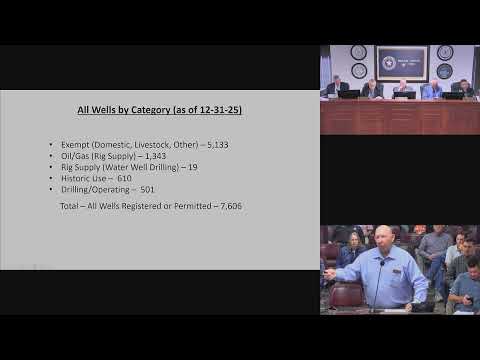
Day walked the court through “desired future conditions” used for long‑range planning and regulation and noted the board is in its fourth round of DFC planning in Groundwater Management Area 12; once the district reaches 90% of a DFC it may invoke curtailment rules to cap pumping. He urged landowners to register exempt wells so the district can protect property rights if nearby permitting later affects shallow wells.
Why it matters: The presentation framed groundwater as a long‑term planning and regulatory issue. The district’s mitigation and monitoring commitments, and a move to per‑acre‑foot permit fees, are intended to preserve water availability as region‑level growth (including data centers and other large users) continues.
What’s next: Day encouraged residents to visit brazosvalleygcd.org for data and said his staff will continue outreach, school education programs and annual reports as the district finalizes updated desired future conditions by year’s end.