Lifetime Citizen Portal Access — AI Briefings, Alerts & Unlimited Follows
Kane County riverboat grant committee keeps near 80/20 split, forwards $3.9M in internal recommendations after debate over lobbyist funding
Loading...
Summary
The Kane County ad hoc Riverboat Grant Committee on April 20 recommended roughly $3.9 million in internal fiscal-year 2027 allocations while retaining an approximate 80/20 internal-to-external funding target. Members split over whether to fund the county's lobbying contract and whether payroll items belong in the fund; the committee forwarded its recommendations to the executive committee.
Kane County's ad hoc Riverboat Grant Committee on April 20 reviewed fiscal-year 2027 internal grant requests and voted by consensus to forward staff-recommended allocations to the executive committee while keeping an approximate 80% internal / 20% external funding target.
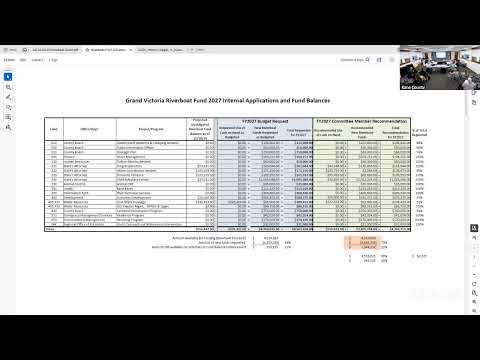
Chair Chris Caius opened the meeting and asked staff to present the committee's averages and supporting tables. Mark Mankirkoff, director of development, told the panel that "there's not been a county board resolution or firm policy on this percentage split," and that the 80/20 pattern reflects past practice rather than a hard rule. Staff said the riverboat receipts available for allocation after preserving a working reserve were about $4.9 million, with recommended new internal allocations totaling $3,896,958.06 under the committee's current adjustments.
The committee began the meeting with a public comment letter from resident Steven M. Loeffler, read aloud by staff. Loeffler urged the board to "reconsider" the internal/external balance and to move core county programs off casino-derived revenue, writing that "relying on casino revenues to fund core government functions is poor fiscal policy" and that the county should instead seek stable funding through the general levy.
Members pressed staff on how the 80/20 split was derived and whether unobligated or cash-on-hand balances should be applied to requests. Treasurer for the State's Attorney's Office explained the office's $171,216 request as an operational shortfall and confirmed the office had about $185,000 in unobligated funds; the committee clarified it could authorize departments to spend from those reserves rather than allocate new riverboat funds.
A central point of contention was whether the county's lobbying contract (a roughly $120,000 request identified in applications) should be funded out of riverboat dollars or the general fund. Committee member Bill Leonard argued the contract has produced a strong return, saying the prior investment "got over $2,000,000 in benefit" and that he would support funding it fully from riverboat funds for this year. Several members, including Gumbs and Garcia, countered that a recurring contract is an operating expense and cautioned against converting a grant-style revenue stream into a stable source for payroll or contract obligations. "I do not want to see them put in a fund that is a grant," said member Gumbs, arguing the lobbying expense should be borne by the general fund.
After discussion, the committee decided to include the lobbying contract in the set of items it will recommend to the executive committee and indicated willingness to approve the full request for the current cycle, while noting members' disagreement and the need for full-board review.
The committee was also split over a $50,000 public information officer request. Several members opposed using riverboat funds for ongoing payroll, while others, including the chair, argued the PIO role supports grant administration and public education. Committee members agreed the PIO issue would travel with the package to executive review and could be modified there.
On the county strategic plan request (about $150,000), members noted the prior contract had expired; after discussion a majority supported funding the planning contract as a one-time use of riverboat funds and recommended including the full request in the package.
Staff updated the spreadsheet live to reflect committee choices and unobligated-balance transfers; members agreed to increase water-resources cost-share drainage to the full request (about $304,230), a change that did not materially move the committee off its ~79.21% internal allocation when rounded. Staff reported the committee's recommended new internal allocations as $3,896,958.06 and estimated external awards at roughly $1,000,000 under the current package. The committee voted to forward the recommendations to the executive committee and then adjourned.
Next steps: the executive committee and full board will receive the recommended allocations and may modify amounts or funding sources. The committee record shows several substantive disagreements (notably over recurring payroll and the lobbying contract) that the full board will confront when it considers final budget action.