Lifetime Citizen Portal Access — AI Briefings, Alerts & Unlimited Follows
Commissioners approve Riverbend Townhomes rezoning over strong Middlebury opposition
Loading...
Summary
After a lengthy public hearing in which residents cited traffic, safety for buggies and schools, and concerns about subsidized housing language in Middlebury's 2030 plan, the Elkhart County commissioners voted 2-1 on April 20 to approve primary approval and a zone map change for the Riverbend Townhomes project (112 units).
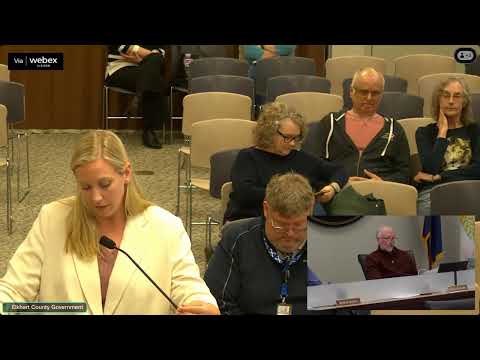
The Elkhart County Board of Commissioners voted 2-1 on April 20 to approve a zone map change and primary approval for the Riverbend Townhomes development near County Road 165 and County Road 116 in Middlebury Township, despite extended public opposition and repeated questions about traffic, sewer capacity and whether the project could later receive subsidies.
Planning staff and the developer said the current proposal has been reduced from an original 152-unit plan to 112 units in 12 buildings, with 248 parking spaces (including 12 designated handicap spaces) and roughly 7 acres of open space on an 11.5-acre site. Zoning administrator Jason Veil told commissioners the plan received a unanimous recommendation from the plan commission and that the development team revised the project in response to neighbor concerns.
Developer Marlon Schwartz said the team "reduced down to the 1 12" to be a better neighbor and emphasized the project is intended to be market-rate housing under private financing. "We're not planning on selling them," Schwartz said, adding the partners manage other local properties and perform tenant screening.
Middlebury town manager Mary Cripe told the board the town supported adding housing options and confirmed utility capacity and intergovernmental arrangements. "Our current capacity is 999,000 gallons per day. We're currently right around 600,000 gallons per day," Cripe said when asked whether the town's wastewater system could handle additional load; she also described an "in-lieu-of-annexation" agreement that allows the project to connect to town utilities without immediate annexation.
Opponents who filled the commissioners' public hearing raised a string of concerns: traffic safety for Amish buggies and schoolchildren, the proximity of the bike trail and cemetery, the reliability of public outreach, and suspicion that the town's "2030" comprehensive plan language could be a vehicle for subsidized or higher-density housing. Several speakers pointed to the plan's language about "young family" and "housing subsidy programs," and one speaker referenced the Low-Income Housing Tax Credit (LIHTC) by name as an example of an incentive that can change a development's financial structure.
"Who said that a town has to grow all the time? Some of us like a small town," resident Ben Doerr told the board, summarizing opposition sentiment that growth should not be presumed. Resident Steph Kaufman urged commissioners to reject rezoning because, she said, the proposal did not reflect community character: "This is unacceptable," she said.
Commissioners debated the balance between property rights, plan consistency and local concerns. One commissioner argued that comprehensive plans are guidance rather than law and warned against micromanaging private property, while another emphasized the county's role in weighing technical standards such as access, water and stormwater. "If you do not grow, you die," one commissioner said, arguing for permitting the owner's request under existing standards.
After deliberation Commissioner (speaker 6) moved to approve the request and the chair (speaker 2) seconded. The recorded roll-call vote was 2 in favor, 1 opposed; chair recorded the outcome as approved. The board moved on to other agenda items following the vote.
What happens next: the approval grants primary approval and a zone map change as requested; developers and town staff will follow standard permitting and any subsequent inspection or infrastructure conditions required by the county and the town. There was no immediate public-confirmed guarantee that the project will be operated without any future public incentives; several residents had asked whether the county has legal ways to enforce a developer's promise not to use subsidies, and staff said zoning approval focuses on land use and design, not on how future private financing may be structured.