Get Full Government Meeting Transcripts, Videos, & Alerts Forever!
Get email alerts on the Vaccines topic
No spam. Unsubscribe anytime.
Connecticut House passes bill creating state vaccine standards and adult program after heated debate
Summary
The House passed HB 5044, which establishes a Connecticut vaccine "standard of care," creates a limited adult vaccine program and clarifies procurement and insurance coverage, and narrows where RFRA applies to certain vaccine mandates; the bill passed after floor amendments and a contentious, multi‑hour debate.
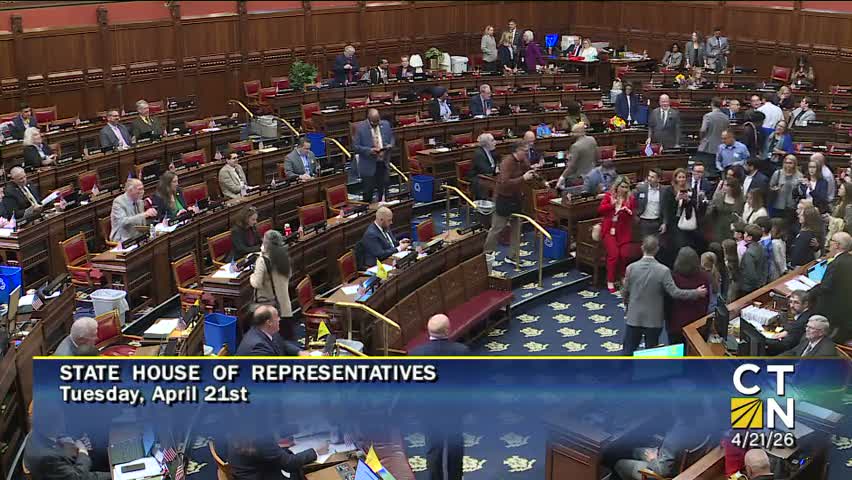
HARTFORD — The Connecticut House of Representatives passed HB 5044 on April 22, 2026, establishing a Connecticut standard of care for immunizations, authorizing a limited adult vaccine program and expanding the state’s ability to procure vaccines outside federal channels if needed, a proponent said.
"This bill is aiming to make sure that we have available, accessible and affordable vaccines for residents in Connecticut," Representative McCarthy Vahey, chair of the Public Health Committee, told the chamber as she moved the committee’s favorable report and urged passage. McCarthy Vahey summarized provisions that retain regulatory review for school and nursing‑home mandates, authorize a state adult vaccine program for un‑ and under‑insured residents and require insurers to cover vaccines that are recommended under Connecticut’s standard of care.
Why it matters: Supporters said the measure safeguards Connecticut’s ability to ensure vaccine access if federal guidance changes or litigation disrupts the federal advisory process. Opponents countered that the bill centralizes too much discretion in the public‑health commissioner and that a provision narrowing portions of the Religious Freedom Restoration Act (RFRA) with respect to vaccine mandates would remove a path to judicial review for people claiming religious objections.
Narrowing RFRA and amendments: Lawmakers ultimately approved two floor amendments. The second amendment narrowed the RFRA carve‑out so it applies specifically to statutory sections governing school vaccines, college and on‑campus housing requirements, childcare centers and family child‑care homes, and certain congregate settings, an effort McCarthy Vahey described as an attempt to limit the change’s scope "as narrow as possible" to vaccine‑related mandates. That amendment was adopted on the floor by voice vote.
The debate: Representative Claire De Stitria and several other members said the bill effectively hands broad authority to a single executive official and removes long‑standing religious protections for people who object to mandated vaccinations. "This bill takes vaccine policy away from the national medical experts, and it hands it to 1 elected official in her department," De Stitria said, warning that the bill would curtail judicial relief for objectors. McCarthy Vahey answered that the changes are intended to preserve continuity of access and that mandates affecting schools and nursing homes would still require the regulatory or statutory steps that exist today.
Operational details and funding: The bill directs the Department of Public Health to establish a recommended Connecticut standard of care for immunizations by consulting named professional bodies (for example, the American Academy of Pediatrics, the Advisory Committee on Immunization Practices, the American Academy of Family Physicians, and the American College of Obstetrics and Gynecology). It also creates an adult vaccine program limited to certain settings (free clinics, municipal health authorities and similar entities) and referenced an appropriations figure discussed in committee of roughly $892,000 as an initial amount for the adult program. McCarthy Vahey said procurement outside CDC channels remains subject to state procurement rules and FDA oversight for vaccine approvals.
Votes at a glance: The House passed HB 5044 as amended on a roll‑call vote; the clerk announced the final tally as 89 yeas, 60 nays, 2 absent. (Several earlier voice and machine tallies during amendment votes were recorded on the floor record; where the transcript reported an amendment adoption without an unambiguous numeric tally, the House record states simply that the amendment "was adopted." )
What’s next: With House passage the bill proceeds as required by the legislative process; any regulatory actions tied to school or nursing‑home vaccine mandates would still require the separate regulatory or statutory steps outlined in current law. Supporters said the Department of Public Health will develop the Connecticut standard and consult advisory bodies; opponents urged caution and said they will press for judicial review and close oversight of any regulatory changes.
The chamber’s proceedings included extended questioning by members, dozens of floor interventions and public testimony submitted during the public‑health committee process. The House record shows the measure prompted sustained public interest and divided votes among members on both policy and process grounds.