Get Full Government Meeting Transcripts, Videos, & Alerts Forever!
Get email alerts on the Cannabis Zoning topic
No spam. Unsubscribe anytime.
Pine County adopts amendments to cannabis zoning after residents raise alarms about lights and odor
Summary
Pine County commissioners voted to adopt Ordinance 2026-17, amending Ordinance 2024-58 to clarify rules for greenhouse/mixed-light facilities, exhaust venting, and retail-only micro/meso operations after staff presentation and extended public testimony about light pollution and odors.
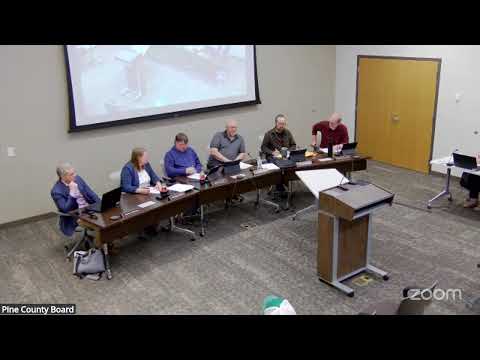
Pine County commissioners approved Ordinance 2026-17 amending Ordinance 2024-58, adopting clarifying changes to how the county regulates adult-use cannabis businesses after a staff presentation and a lengthy public hearing that produced repeated complaints about bright cultivation lights and strong odors.
Tony (S10), the county administrator who presented the changes, told the board the amendments are largely practical clarifications drawn from experience after licenses began flowing in 2025. "Originally, the ordinance was adopted in December 2024. That was prior to any licenses being issued," he said, and the changes reflect how the rules work in practice.
The amendments described by Tony include relettering/cleanup in Section 1.2; moving micro- and meso-businesses that operate retail-only out of a cultivation-focused subsection into the retail section (2.1.4); and clarifying that odor controls apply to specific activities (drying, aging, trimming, packaging) wherever those activities occur rather than only inside hard-sided buildings. The proposal also narrows a rooftop-exhaust requirement so it applies to hard-sided buildings and allows side-exit vents on multi-story hard-sided structures provided the vent is directed upward to approximate rooftop discharge.
During the public hearing, neighbors described repeated nuisance impacts. "These lights are on continuously. This is a little ridiculous," said John De Grey (S7), who said lights from nearby greenhouse operations are visible many miles away. Royalton Township resident Niecewise (S6) cited research about rural population trends and warned that persistent nuisances could discourage families from moving back into rural communities, saying "safety and security is number 1" for people considering a return.
Grower representatives and operators told the board they have followed state and county requirements. "We got inspected by the state, the county before we were licensed to operate. We will continue to follow the ordinances, whatever you decide to change or fix," said Joe Zapat (S11), who described local hiring, vendor spending and plans for a 1.3-acre outdoor grow. Trent Cannebrook (S12), who has toured facilities nationwide, said he has seen no odor at some area sites and praised the county's approach: "Pine County is leading the state with regard to cannabis," he said.
Commissioners pressed staff on several unresolved technical points. Several members noted the ordinance uses the term "objectionable odor" without an objective definition; Commissioner remarks and staff underscored that establishing a parts-per-million standard would likely be a state-level or MPCA (Minnesota Pollution Control Agency) task and could be beyond the county's technical scope. Tony confirmed that OCM (Office of Cannabis Management) considers greenhouses to be "mixed-light/outdoor," which changes what mitigation approaches are feasible.
After discussion, a motion to adopt Ordinance 2026-17 (which amends 2024-58 to implement the clarifications described above) was moved and seconded. The board approved the ordinance by voice vote; a roll call was not taken.
The amendments will be implemented through the county's zoning and permitting process. Board members and staff said additional or more technical questions — including a precise definition of "objectionable odor" and what constitutes a "rebuilt greenhouse" — may be referred back to the zoning board or to state agencies for further guidance.
The board handled the ordinance adoption as part of its regular agenda and then moved on to other county business, including personnel committee recommendations and a resolution supporting a manufacturer’s job-creation grant application.
The ordinance as adopted clarifies county enforcement focus on specific odor-generating activities and on tailoring exhaust requirements to building type; it also reclassifies retail-only micro/meso endorsements so retail operations are regulated under the retail rules rather than cultivation-focused rules. Implementation details and any more prescriptive mitigation standards were left for future zoning work or state agency action.