Get Full Government Meeting Transcripts, Videos, & Alerts Forever!
Get email alerts on the Land Use Variance topic
No spam. Unsubscribe anytime.
Morris Township board hears final testimony in contested South Street Gardens D1 use-variance; hearing continued for conditions
Summary
The Board of Adjustment heard competing expert testimony on a D1 use-variance for South Street Gardens' proposed garden center, cafe and event space—disputes centered on as-built differences from the site plan, whether the project triggers state major-development stormwater rules, and whether amplified outdoor music can meet the township's noise limits. The board carried the matter to May 18 to consider conditions and public comment.
The Morris Township Board of Adjustment on April 15 heard recall testimony in a long-running application by the owners of South Street Gardens seeking a D1 use variance to operate a garden center that would include a coffee shop and a small event space.
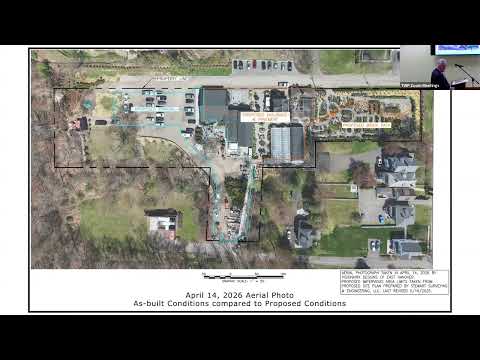
Applicant witnesses and opposition experts sharply disagreed over what is already on the ground at 383 South Street and what would be allowed if the board approves the applicant's site plan. Opponents introduced an aerial photograph marked as an exhibit that they said shows additional paved and graveled areas, new storage containers near the wetlands and changed front walkways not shown on the Stewart site plan. John Weiskerber, the objectors' aerial consultant, told the board the photo shows a larger impervious footprint than submitted to the board.
Applicant counsel disputed the photograph's value as quantitative engineering evidence and said it should be treated as a visual exhibit. The applicant's civil engineer, Patrick McClellan, said his field testing and a forensic review of soils and historical aerials indicate that much of the rear lot has compacted, low-infiltration soils that meet New Jersey's definition of —impervious— for stormwater purposes. McClellan concluded the proposed plan would not trigger the state's "major development" thresholds and, he said, the plan reduces net impervious cover compared with current conditions.
Opposition planner Alexander McLean, called as an expert by objectors, disputed that conclusion and told the board the record does not show the garden-center uses are permitted in an RA-15 district and that the applicant must meet the D1 positive- and negative-criteria (the Medici standard). McLean highlighted evidence from a prior civil engineering witness that estimated an increase in impervious surface and cited wetlands and noise impacts as reasons the application could fail the negative criteria.
On operations, applicant representative Matthew Bruin described the business as a family-run re-use of an older nursery complex, said the family has invested in site improvements and cleanup, and confirmed the temporary presence of a family-operated food truck until a cafe build-out is complete. Bruin said the family would follow any conditions the board imposes.
Noise was a focal point. The applicant's acoustical consultant, Benjamin Mueller, presented a March 25 sound survey that tested the existing indoor sound system and several outdoor speaker setups in the two courtyard areas. Mueller said measured levels at the property lines during his tests were generally in the low-to-mid 50 dB to low 60 dB range and therefore below the township's 65 dB property-line limit; he recommended technical controls (distributed speakers, limiters) and owner-managed calibration so that outdoor amplified events could comply with the code. Opponents pointed to a recorded resident video in the earlier record that they said showed louder, audible music; Mueller said audibility does not always correlate with a code violation and that regimens such as pre-event testing, onsite sound meters and owner control reduce the risk of exceedances.
Board members and professionals discussed options the board could impose by condition: limiting the number or hours of outdoor amplified events, requiring owner-controlled audio systems (rather than unregulated vendor-supplied rigs), pre-event calibration and a test at time of CO, limits on food-truck permanence, and post-approval inspections to confirm down-shielded lighting and site-plan compliance.
With witnesses concluded, the board continued the hearing to May 18 at 7:00 p.m. for public comments, discussion of conditions, any closing statements, and board deliberation.
What happens next: the May 18 session will let interested residents revisit the record, allow the board to propose and negotiate conditions (for example, limits on amplified outdoor music, a restriction on permanent food-truck operations, checks on impervious-area remediation and any required site-plan corrections), and then to deliberate on approval or denial. Any final decision will include the specific conditions the board adopts and, if approved, how the board intends to enforce them (inspections, thresholds for violations, or requirement to return to the board for changes).