Get Full Government Meeting Transcripts, Videos, & Alerts Forever!
Get email alerts on the School Bond topic
No spam. Unsubscribe anytime.
Norris School District 160 presents $34.8 million bond plan to replace roofs, HVAC, add secured entrances and ease campus traffic
Summary
District leaders described a proposal for a $34,800,000 bond on the May 12 ballot to fund roof and HVAC replacements, secured entries, traffic and ADA work, and answered residents' questions about tax impact—estimated at about "9 and a half cents" on current valuation.
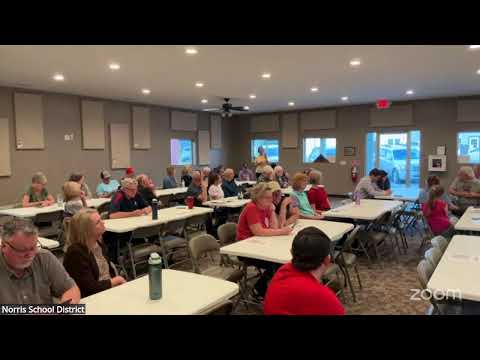
Superintendent Derek Choll told a packed town-hall meeting that Norris School District 160 is asking voters on May 12 to approve a $34,800,000 bond to address aging roofs and heating, ventilation and air-conditioning systems, add secured entrances and improve campus traffic and ADA compliance.
The district presented the bond as a response to long-deferred capital needs identified in a facility audit completed by JDO. "JDO had completed our facility audit, which is where this comes from," Choll said, and the district's steering committee and five-year plan guided the project list.
Presenter speaker 4 said the high school scope would include full HVAC replacement and controls and roof work; the plan also proposes a "South Loop Road" to reroute school buses, move the transportation department off the campus heart, add parking and a dedicated elementary pickup/drop-off to reduce congestion. "Currently, what is being proposed is all new HVAC at the high school," the presenter said.
Choll and staff explained how the district finances capital work. He described two buckets of funds: a general fund used mainly for staffing and operations, and a special building fund used for major projects. Because of statutory levy caps and past decisions to limit local tax asking, the district said it has not been able to accumulate enough special-building reserves to cover all of the needed work without a bond.
On tax impact, Choll gave an example estimate: "that 9 and a half cents is a conservative number that includes our current bond debt," meaning the tax per $100 of assessed valuation on current rolls. He added that the figure is modeled on a flat-valuation assumption and would decline if local property valuation increases.
Residents asked detailed questions about priorities and past spending. One attendee asked whether the district should prioritize older homeowners rather than school projects; Choll said the board has tried to minimize the tax asking while addressing safety and critical maintenance. Another attendee sharply challenged budgeting practices, saying the district "doesn't do a **** thing to put a single nickel in either bucket," which drew responses from administrators who cited statutory limits, capital needs, and rising costs.
Choll and presenter staffers also described items the district has already funded from depreciation or other sources: recent LED exterior-lights and partial roof section replacements, and gym bleacher and floor work completed with depreciation funds rather than the bond. The district said the bond amount is a maximum-guaranteed figure and that bid results and prioritization would determine the final package of work.
Officials encouraged residents to use the bond website's calculator to estimate individual impacts and said staff would remain after the meeting to answer questions. Choll noted one more town-hall meeting planned in Hickman before the vote.
If the bond passes, the board will oversee bidding and prioritization; if it fails, district leaders said they will re-prioritize projects through the annual budget and depreciation fund but acknowledged the work would proceed more slowly and could cost more over time.
The town hall included back-and-forth exchanges about enrollment projections, the capital fund known locally as QC5, the district's decision to finance a prior sports project through a lease purchase rather than depleting reserves, and how many SROs the district employs. The district said it currently has one school resource officer who splits time between the high school and the middle school.