Get Full Government Meeting Transcripts, Videos, & Alerts Forever!
Get email alerts on the Sb280 topic
No spam. Unsubscribe anytime.
Committee reviews SB 280: AVT rates, allocation and $1M-per-mile construction impact fee; concerns raised about equity and tax trade-offs
Summary
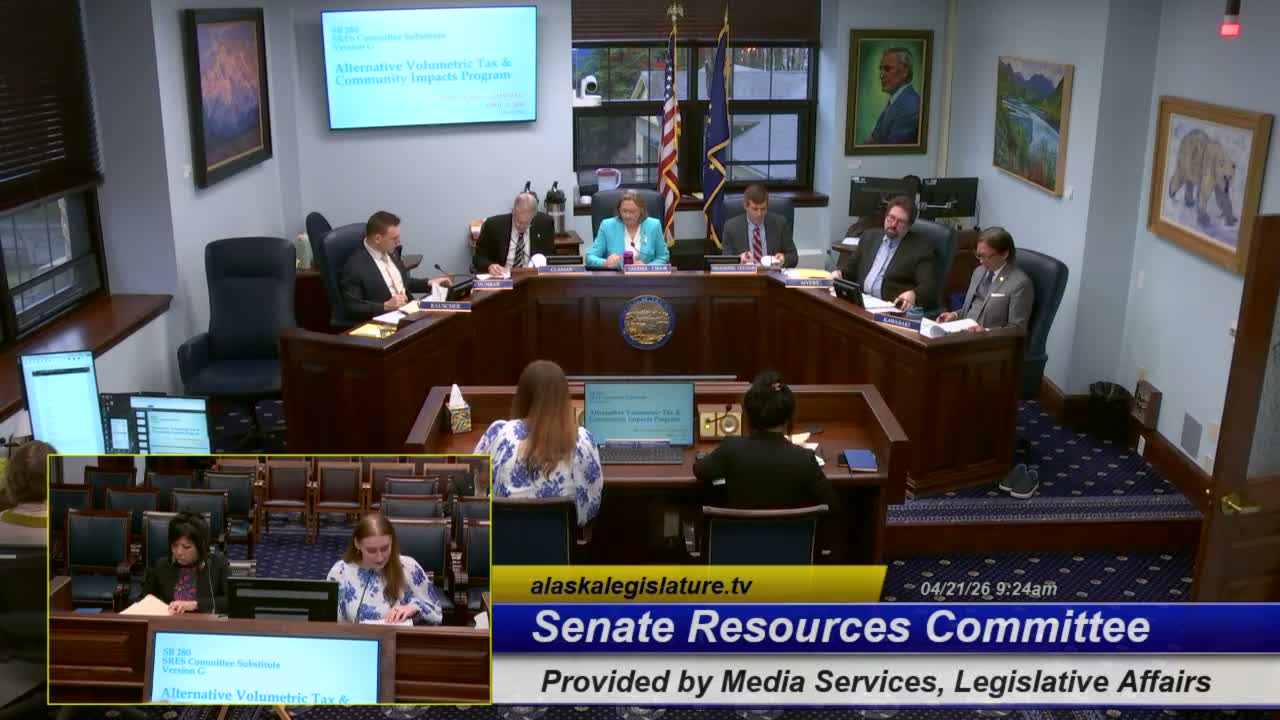
The Senate Resources Committee heard an extended sectional review of Senate Bill 280 on April 21 outlining an alternative volumetric tax (15¢/1,000 cf pipeline and GTP; 25¢/1,000 cf LNG), a $1,000,000-per-mile community impact fee during construction, AGDC transparency and legislative-approval provisions, and revenue allocation formulas; Department of Revenue modeling and committee members raised equity and timing concerns.
The Senate Resources Committee spent substantial time on April 21 reviewing Senate Bill 280, a committee substitute that would create an alternative volumetric tax (AVT) and a construction-era community impact fee for a proposed natural gas pipeline and related facilities, add reporting and public-disclosure requirements for the Alaska Gasline Development Corporation (AGDC), and modify tax and production valuation rules.
Paige Brown (staff) read a sectional analysis that described many detailed provisions: excluding qualified pipeline property from education funding full taxable-value calculations; exempting AVT-subject pipeline property from municipal property-tax caps; adding AGDC confidentiality limits and requiring legislative approval before AGDC or subsidiaries transfer ownership or issue bonds; and establishing prevailing market-value rules for production tax determinations. The CS also sets failure contingencies that would repeal AVT provisions if construction has not started by Jan. 1, 2028, or commercial operations have not begun by Jan. 1, 2032.
Senate majority legal counsel Sonia Kawasaki presented background and the AVT mechanics. The bill’s AVT rates in section 33 would be 15¢ per 1,000 cubic feet for pipeline throughput and gas treatment plant throughput, and 25¢ per 1,000 cubic feet for LNG plant throughput, fixed for 10 years then adjusted by an Alaska-specific consumer price index. Kawasaki described a revenue-allocation plan that would send 50% of pipeline proceeds to corridor municipalities (by mileage) and 50% into a statewide per-capita community assistance distribution; analogous 50/50 splits would apply to the gas treatment plant (North Slope) and export facility (Kenai Peninsula Borough).
Dan Stickel, chief economist with the Department of Revenue, provided baseline comparisons under current law: "we were looking at about $736,000,000 per year of total property tax burden," he said, which he broke out as roughly "$239,000,000 to the state and $497,000,000 to the municipalities." Committee members used those baseline numbers to compare the AVT's modeled revenue (presenters earlier cited an ABT example of about $610,000,000) and to flag that substituting AVT for existing property taxes could produce winners and losers across boroughs and school funding calculations.
Senator Dunbar and others raised constitutional and equity concerns about excluding pipeline property from full taxable property-value calculations used in the school funding formula, asking whether AVT revenue (or a portion of it) could be counted toward a district’s required local contribution without leaving some communities better or worse off. Legislative legal staff said drafting options exist but noted practical valuation challenges and promised further analysis.
Presenters also described a community impacts program (construction phase) imposing a $1,000,000-per-mile impact fee on the developer, with annual grants administered by the Department of Community and Commerce and Economic Development to communities experiencing direct construction impacts. Administration representatives participating remotely warned that front-loading large payments could increase early project costs borne by initial pipeline customers and underscored ongoing discussions with municipal leaders.
No formal committee votes on SB 280 were recorded at the April 21 meeting; Chair Giesel said the bill would be set aside for further review and that mayors and other witnesses were expected at future meetings.
What’s next: Committee follow-up will include additional briefings, requested modeling or valuation work from the Department of Revenue and draft options from legislative legal services addressing equity and local-contribution calculations.