Get Full Government Meeting Transcripts, Videos, & Alerts Forever!
Get email alerts on the Impact Fees topic
No spam. Unsubscribe anytime.
Idaho Falls adopts 2026 capital plan and updates impact fees after debate over basements
Summary
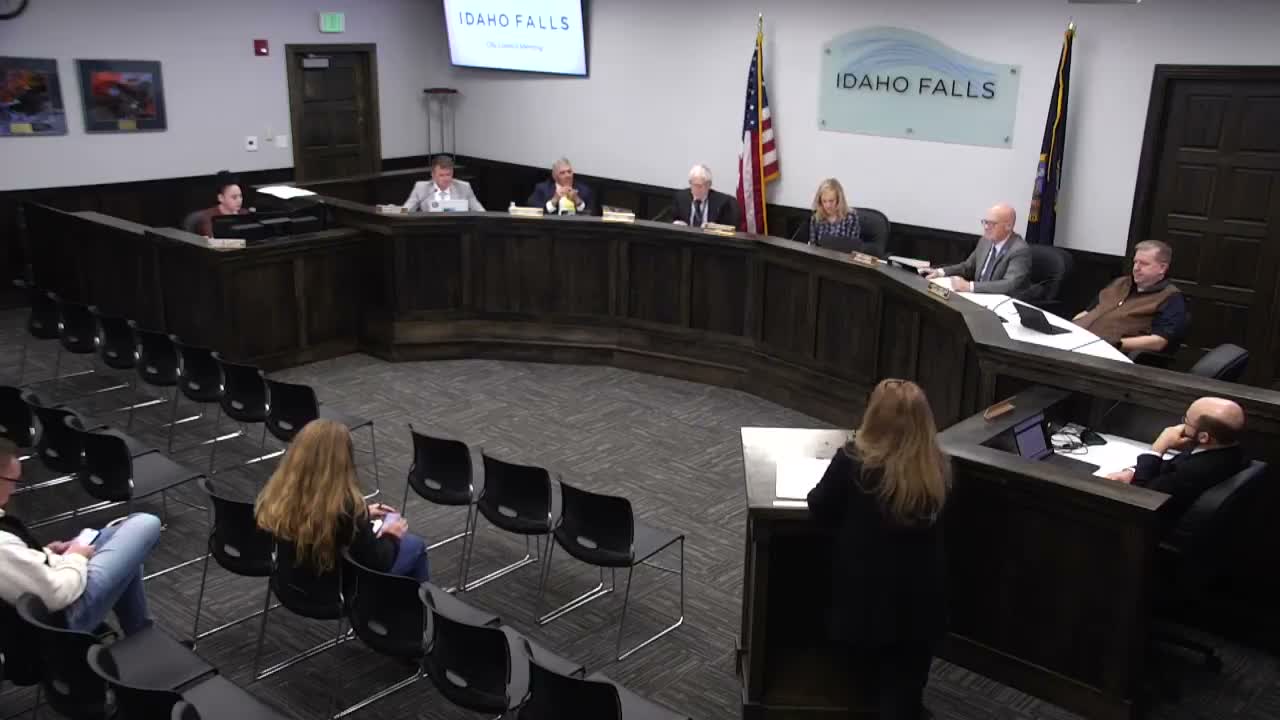
The Idaho Falls City Council on April 23 adopted a 2026 Capital Improvement Plan and an updated development impact fee study and amended city code to implement revised fees, setting the ordinance to take effect June 1, 2026. Builders and councilors debated whether unfinished basements should be excluded from fees; council adopted the documents and code changes after deliberation.
The Idaho Falls City Council on April 23 adopted the city’s 2026 Capital Improvement Plan and an updated development impact fee study and approved amendments to Title 10, Chapter 8 of the city code to implement the new fee schedule, with the ordinance set to take effect June 1, 2026.
Municipal Services Director Alexander and the study’s consultant, Colin (consultant, Tischlofeis Galena), told the council the study updates the city’s fee methodology and ties fees to projected capital needs across transportation, parks and recreation, police and fire/EMS. The study recommends tiered residential fees based on dwelling square footage (three bands: under 1,500 sq. ft.; 1,500–2,900 sq. ft.; and 3,000+ sq. ft.) and maximum supportable commercial fees by thousand square feet.
Builder representatives at the hearing urged the council to reconsider the square‑footage approach and questioned credits for existing balances. Erin Cannon of Comfort Construction, who said she has built predominantly in Idaho Falls since 1998, said she was "here to ask you to make sure that we get it right this time," arguing that a square‑footage method can penalize smaller households and that credits for existing balances could raise legal issues for refunds. Todd Webb, who identified himself as a home builder, said rising impact fees make entry-level housing harder to afford. Nate Clark, speaking for Rockwell Homes, urged the council to base impact charges on finished, habitable square footage rather than total building area so fees align more closely with likely occupancy.
Consultant Colin and Director Alexander responded that the study follows statutory procedures and recognized standards. Colin explained that credits reduce the fee to account for previously collected funds so the city does not "over‑collect" for projects already partly funded. Director Alexander described the accounting and tracking process for impact fees and noted the city’s quarterly reporting and ledger reconciliation.
Council deliberations focused on whether the ordinance’s square‑footage definition should exclude unfinished basements. Supporters of an exemption said excluding unfinished basements would aid housing affordability and reflect usage differences between finished and unfinished space. Opponents said impact fees are a one‑time charge based on the long‑term demand a structure will place on services and that square footage helps make the fee defensible over the life of the building.
After debate and procedural votes, the council adopted the resolution adopting the CIP and development impact fee study and then moved to adopt amendments to City Code Title 10, Chapter 8 that reflect the study and set the fee schedule. Council set the ordinance’s effective date as June 1, 2026, to align implementation with administrative timelines.
What happens next: the ordinance will take effect June 1, 2026, and the city will implement the new fee schedule on that date. Council members said the policy will be revisited as required by state statute and that staff will provide training and implementation guidance for departments. Public comment and council discussion signaled continuing attention to affordability and to whether the city should refine definitions or future credits in subsequent cycles.
Sources: municipal services presentation and public hearing testimony at the April 23, 2026 council meeting.