Get AI Briefings, Transcripts & Alerts on Local & National Government Meetings — Forever.
West Palm Beach unveils draft downtown master plan update proposing taller, thinner towers, new incentives and waterfront park vision
Loading...
Summary
City staff and consultants presented a draft Downtown Master Plan update that would expand incentive zones, allow taller incentive heights in limited areas, sell city development rights to fund mobility and public‑space maintenance, and require workforce housing set‑asides. Board and public questions focused on feasibility, displacement and transportation.
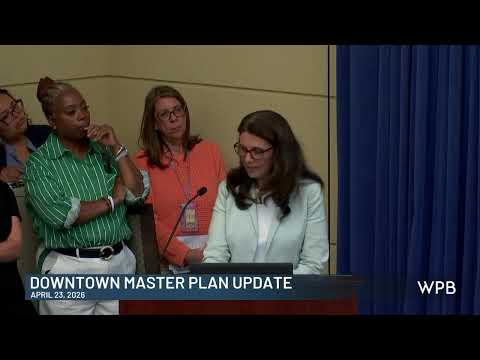
City of West Palm Beach staff and consultants presented a draft update to the Downtown Master Plan at a workshop, proposing changes to zoning, incentives and the waterfront that officials said are intended to manage rapid downtown growth while funding public benefits.
Anna Maria Aponte, Development Services Director, opened the meeting and framed the update as a recalibration of policies first adopted in 1994 and revised in 2007. ‘‘This is a draft document,’’ Aponte said, and staff will seek public and board feedback before returning with a final version for hearings next month.
Consultant Bernard Siskovich said the plan is driven by a 20‑ to 30‑year vision to keep West Palm Beach ‘‘a nationally recognized urban destination’’ while addressing congestion, housing affordability and resiliency. He explained the approach: a base development capacity plus purchasable incentives that allow additional floor‑area ratio (FAR) and heights in targeted core areas. ‘‘So we're looking at increasing the area of incentive and allowing for more development,’’ Siskovich said.
Key elements presented include: a zoning framework that separates base height from incentive height (with incentive heights tested up to about 25 stories in limited core areas); tower‑length limits (generally 200–250 feet, corners up to 300 with shape requirements); podium and setback rules to protect street character; active ground‑floor requirements (about 80% active frontage in high‑activity areas); and design controls to preserve view corridors to the Intracoastal.
A major funding proposal would create city development rights (CDRs) sold at an initial rate the presenters described as $17 per square foot. Aponte said the money collected from CDRs would be reinvested: ‘‘75% mobility improvements and then 25% for maintenance of public spaces.’’ The team proposed that projects using incentives must set aside 20% of the additional square footage for workforce housing, and they would expand the eligible income bands for those units to roughly 60–120% of area median income, with options for on‑site units, off‑site units or payment‑in‑lieu.
On transportation, Aponte described a separate Ride WPB program: a fixed‑route pilot (north–south in the first year, east–west in the second) with continued on‑demand service, funded in part by a city mobility fee that replaced the county roadway impact fee. She said some mobility fee revenues are already being used to design a Fern Street extension across the rail corridor.
Board members pressed technical questions about small‑lot feasibility, variances, loading and delivery space, the 80% active‑use target, and whether the proposed height and FAR tests are compatible with typical building economics. The consultants said they had tested parcel configurations and incentives but acknowledged site‑specific variances would still be part of the process.
Aponte closed by outlining the schedule: Downtown Action Committee review in May, Planning Board consideration in mid‑May, a proposed City Commission hearing in July with second‑reading timing in September if the process proceeds as planned.
The workshop will be followed by additional public hearings; staff asked attendees to submit comment cards for those who want to speak at the public record portion of the process.