Get Full Government Meeting Transcripts, Videos, & Alerts Forever!
Get email alerts on the Education Policy topic
No spam. Unsubscribe anytime.
Maple Heights board approves Lean Six Sigma training, Chromebook purchase and routine business; introduces new technology director and principal
Summary
At its April 27 meeting the Maple Heights board approved a Lean Six Sigma training contract for staff, authorized a Chromebook purchase (with third graders to use devices at school only), adopted two administrative resolutions and confirmed two hires for 2026–27. A student group ran a mock vote as part of a Teacher Academy visit.
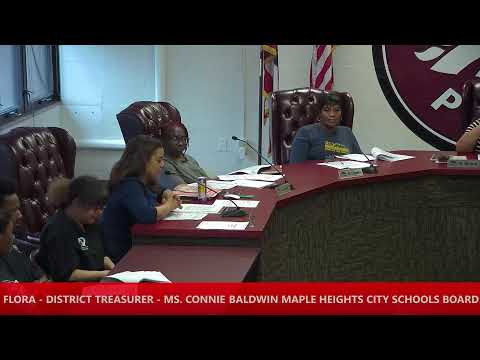
The Maple Heights Board of Education met April 27 in the district boardroom and approved a set of routine and programmatic items including a contract to expand a Lean Six Sigma certification program for teachers, a purchase of Chromebooks for student use, and two administrative resolutions addressing contract notifications and transportation exceptions. The meeting also featured a Teacher Academy visit during which students conducted a mock vote.
The board unanimously approved a contract to expand the district’s Lean Six Sigma program after Dr. Shay Price, the district’s director of curriculum and instruction, described plans to train 10 teachers as “educational black belts” who will enable students to earn yellow and green belt certifications across courses. “We’re trying to embed this in our programs throughout so that when students leave us, they’ll have it,” Dr. Price said, describing how the credential can bolster students’ postsecondary and career opportunities.
The approval followed a formal motion and roll call. The board also approved several routine governance items by roll call, including minutes from the April 13 committee‑of‑the‑whole meeting and the March 2026 financial report.
A finance staff member explained a county change in tax collection timing that will alter advance payments to districts. Officials said Cuyahoga County will now send advances only in September and March rather than multiple advance payments across the year, which the district will absorb given a current cash carryover but will monitor for cash‑flow impacts.
The board approved a “physical certificate” process covering purchase orders when invoices arrive before a PO is in place. The staff explanation noted that purchases over $3,000 require board acknowledgment that cash was available to pay those bills when they come due.
Board members also debated and approved a purchase of Chromebooks. Discussion centered on third‑grade device use: a board member asked how often third graders would use Chromebooks and whether they would be able to take devices home. Administration said third grade is the first grade level that tests on computers (the state OSTs), that Chromebooks are used in ELA and math to build familiarity with testing and practice skills, and that the district currently does not allow third graders to take devices home. “There’s a balance between teacher‑led instruction and device use,” administration said, adding the district plans to embed device use while preserving handwriting and paper‑based work.
Two administrative resolutions were adopted. Resolution 26‑29 directs the treasurer to notify administration and employees appointed under RC section 3319.02 of contract expiration dates. Resolution 26‑30 declares transportation by school conveyance impractical for certain identified students and offers payment in lieu of transportation; both motions passed on roll call.
Earlier in the meeting Rick Wakefield, lead of the Teacher Academy program, introduced his students and outlined program successes — state and national qualifiers and two state officers for Educators Rising Ohio — then guided the students through a classroom portfolio exercise that included a mock board vote on a proposed senior dress code (presented as Resolution 26‑13 for practice). Students completed a roll‑call practice vote, which Wakefield and the board framed as a learning exercise about governance and Robert’s Rules.
The board introduced and welcomed Dr. Felicia Jackson as the incoming director of technology and Crystal Wilkins as the next principal at Abraham Lincoln Elementary. Each offered brief remarks thanking the board and expressing enthusiasm about joining the district.
The public comment period drew no speakers. The board then moved into executive session on personnel matters at 6:41 p.m.; no action was taken before recess was called.
Votes at a glance • Mock: Resolution 26‑13 (student practice dress‑code vote) — Result: 5 yeas, 2 nays (class exercise). • Approve April 13 minutes — Result: approved by roll call. • Approve financial report (March 2026) — Result: approved by roll call. • Approve physical certificate/purchase order authorization (items over $3,000) — Result: approved by roll call. • Approve Lean Six Sigma contract (training 10 teachers) — Result: approved by roll call. • Approve Chromebook purchase (third‑grade devices; district retains policy on home use) — Result: approved by roll call. • Adopt Resolution 26‑29 (notify employees under RC section 3319.02 of contract expirations) — Result: adopted by roll call. • Adopt Resolution 26‑30 (transportation impractical/payment in lieu) — Result: adopted by roll call. • Amendments to consent agenda (items a–j) and personnel appointments (Dr. Felicia Jackson, Crystal Wilkins) — Result: approved by roll call.
Why it matters: The training contract and Chromebook purchase signal the district’s emphasis on workforce credentials and on integrating technology before state testing in third grade. The tax‑timing change and procurement rules are near‑term fiscal items the district said it will monitor. Appointments fill two leadership roles that will shape technology and elementary programming next school year.
Sources: Board meeting, Maple Heights Boardroom, April 27, 2026. Quotes and on‑the‑record explanations are attributed to district staff and presenters who spoke at the meeting.