Get Full Government Meeting Transcripts, Videos, & Alerts Forever!
Get email alerts on the Allegations Of Suppression topic
No spam. Unsubscribe anytime.
Former DHS investigator tells House panel senior officials tried to suppress CCAP fraud findings
Summary
Retired investigator Jay Swanson testified that a DHS management response in 2017 undercut criminal investigations into CCAP fraud, including an allegation that he was told to delete material destined for the Office of Legislative Auditor and that investigator resources were sidelined.
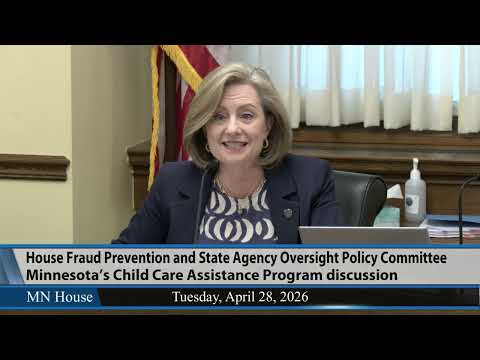
Jay Swanson, who led the DHS recipient and child care provider investigations unit from 2014 until mid-2019, told the House Fraud Prevention and State Agency Oversight Committee that his team's fraud investigations uncovered large-scale billing schemes and that, over time, support from DHS leadership diminished.
"When I forwarded my answer regarding what fraud trends we were seeing in CCAP as I had been directed, I soon had a senior DHS official in my office angry ... told me to delete a number of paragraphs of the document that I had sent," Swanson told the committee, describing an episode in 2018 when he was preparing answers for the Office of Legislative Auditor.
Swanson described investigatory techniques used by his unit — surveillance, forensic examination of seized electronic devices, and coordination with BCA and federal partners — and cited a 2017 federal indictment and 2018 conviction involving the owner of Salama Child Care Center as an example of criminal enforcement his unit helped generate. He said the unit had stopped payments to 11 centers they could prove had billed fraudulently and that five cases led to felony convictions during the period he described.
Swanson also described structural changes in 2017 that, he said, curtailed the unit's discretion: creation of a three-member committee to approve investigations (with two members he said lacked fraud-investigation experience), deprioritizing cases by amount of CCAP funding, limits on investigators contacting BCA without DHS permission, and removing BCA office space at DHS. He said those changes, along with personnel turnover, caused him to resign in mid-2019.
Why it matters: Swanson's testimony links the early investigative work that led to prosecutions and stop-payment orders with a later administrative shift toward faster, lower-depth administrative sanctions that, he argues, reduce criminal deterrence. Swanson told lawmakers that administrative-only outcomes allow operators to reopen centers under related individuals and continue billing public funds.
Swanson said DHS investigators found striking evidence of fraud in some cases, including text messages in which an owner asked, "how much longer are you gonna do the daycare scam?" and an owner describing plans to "buy some nice homes in Nairobi." He said some centers billed $700,000 to more than $1,000,000 a year and that in some counties there were hundreds of CCAP-funded centers with unusual billing patterns.
Committee members asked for documents and a list of staff who worked on those investigations; the chair said committee staff had not been able to locate criminal convictions since 2017 and asked Swanson and agency witnesses to provide case names and records to reconcile those counts.
What happens next: The committee requested follow-up records, including Swanson's submissions to the OLA, names of staff who worked in the prior criminal-investigation unit, and documentation of referrals to prosecutors for the committee to review.