Get AI Briefings, Transcripts & Alerts on Local & National Government Meetings — Forever.
State officials outline small‑business loans, SSBCI funds and Nourish Maryland awards at Baltimore County webinar
Loading...
Summary
Maryland housing and commerce officials told Baltimore County businesses about loan programs (Neighborhood Business Works and Own Your Future), a $200 million SSBCI credit initiative, a newly awarded round of Nourish Maryland grants (~$3.6M) and an upcoming loan‑guarantee program, and invited applicants to contact staff.
Assistant Secretary Brad Fallon and Commerce staff on Thursday described multiple state programs available to Baltimore County businesses and community organizations, including direct loans, federal SSBCI credit resources and a fresh-food grant program that just distributed initial awards.
Fallon, assistant secretary for business development at the Maryland Department of Housing and Community Development, told the county-hosted webinar that Neighborhood Business Works provides "loans for up to $2,000,000 for any small business" (defined in his remarks as firms with 500 or fewer employees) and that underwriting can be flexible on interest and amortization to fit community-focused projects.
The state also manages a federal infusion under the State Small Business Credit Initiative (SSBCI). "That is about $200,000,000 that the federal government...provided to the state of Maryland to get funding out into the small business community," Fallon said, describing SSBCI as a mix of credit-enhancement tools and direct lending that generally requires a 1:1 private-lending match. He warned that Treasury rules create program limits: projects must be at least 60% owner-occupied, cannot exceed $20,000,000 in total project costs and, in some program variants, exclude residential units.
Fallon described "Own Your Future," a program offering loans up to $5,000,000 to help businesses purchase facilities they currently lease, citing the Qube Cowork project in Baltimore as an early example. "It became clear to them that they could save dramatically each month if they owned the building," he said.
On food access, Fallon announced the first round of Nourish Maryland Fresh Food Access awards, saying the state made "just over $3,600,000 in initial awards" in grants ranging from $25,000 to $150,000 to retailers in designated low-access areas. He said the first round drew more than $12.5 million in eligible applications and that the program is a five-year commitment with $2,000,000 per year from the state government and $1,650,000 from a federal rural health transformation program.
Fallon also previewed a small-business loan guarantee program described as similar to the Small Business Administration's approach, which would make community-impact lenders and CDFIs more able to leverage private capital. He briefly noted ongoing Opportunity Zone designation work as another tool for large projects.
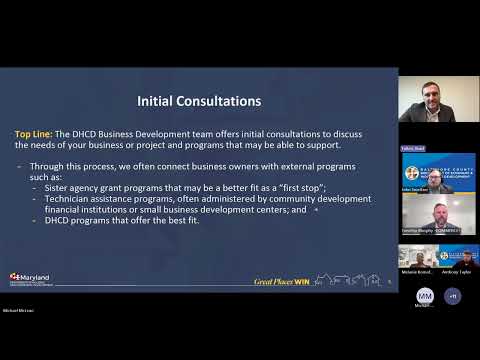
Speakers on the webinar emphasized that many programs involve partner organizations (CDFIs, community development partners, local small-business development centers) and that an intake team is available to help applicants prepare for underwriting and match them with appropriate resources. Fallon said he would provide contact information for follow-up and encouraged businesses and community partners to reach out.
Tim Murphy, senior business development manager at the Maryland Department of Commerce, opened a Commerce overview immediately after Fallon's presentation and signaled additional state resources would be described by Commerce staff later in the session.
Next steps: officials invited interested businesses to request an intake consultation with the state's business development officers and watch for announcements about the loan‑guarantee launch and Opportunity Zone guidance; Fallon said staff contact information would be shared after the presentation.