Get Full Government Meeting Transcripts, Videos, & Alerts Forever!
Get email alerts on the Imd Waiver Legislation topic
No spam. Unsubscribe anytime.
Lawmakers hear expert caution on IMD waivers as committee debates $49,000 appropriation
Summary
A national expert warned the committee that Medicaid IMD waivers produce mixed results; legislators debated draft bill 27.01010.01, a $49,000 appropriation to seek a Section 1115 waiver, and asked the Department of Health and Human Services for implementation details.
State and tribal officials heard expert testimony and debated a draft appropriation to pursue Medicaid waivers intended to allow federal reimbursement for services in institutions for mental diseases (IMDs).
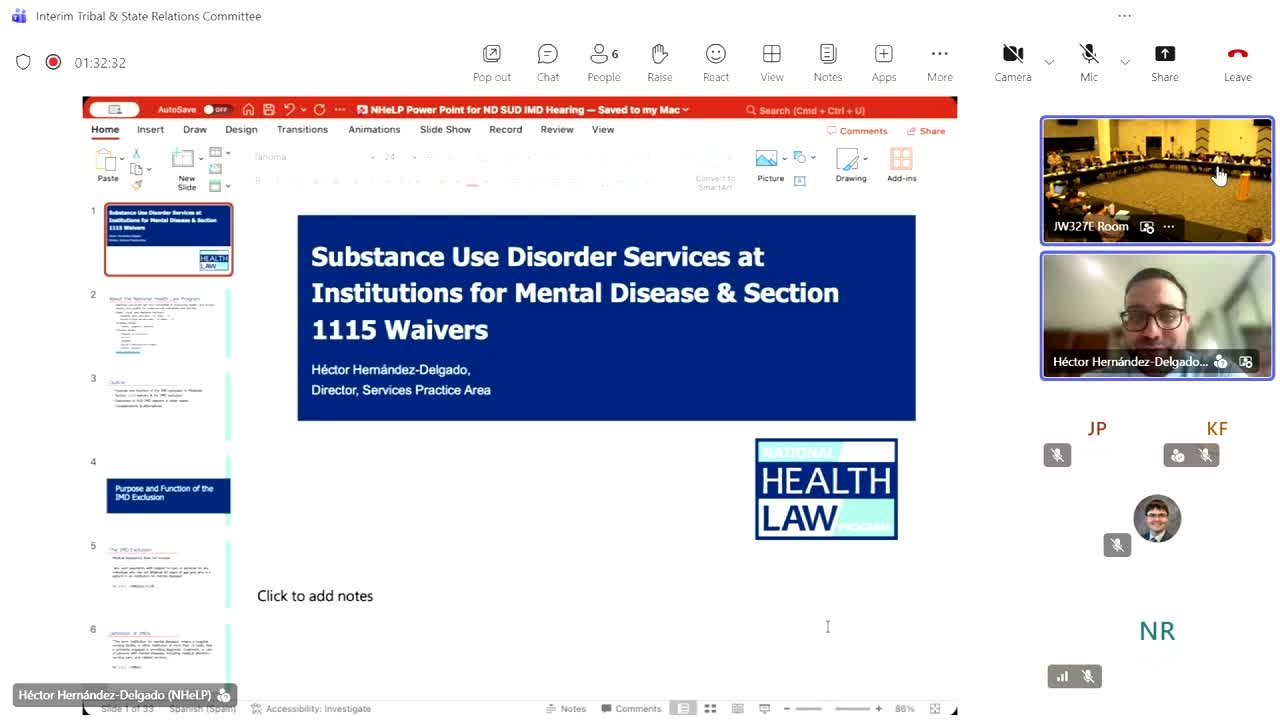
Hector Hernandez Delgado of the National Health Law Program told the committee the IMD exclusion was written into Medicaid in the 1960s to deter large‑scale institutionalization and to incentivize community‑based services. He cautioned that 1115 demonstrations can expand federal funding for residential SUD and mental‑health services but carry administrative complexity and mixed evaluation results.
"The IMD exclusion was thought of as an important piece of civil‑rights legislation that sought to protect individuals with behavioral health conditions from the dangers of institutionalization," Hernandez said. He summarized state evaluations showing some gains in medication initiation in places like Minnesota and Nebraska but also examples where ambulatory and preventive care declined or where increased residential capacity did not uniformly reduce overdose deaths.
Committee staff member Casey read draft bill 27.01010.01, which would appropriate $49,000 and authorize one full‑time equivalent at the Department of Health and Human Services to apply for Section 1115 Medicaid waivers and report back to legislative management and the 71st Assembly. Lawmakers questioned whether the $49,000 figure was adequate seed money for a process many described as a multi‑year, administratively heavy demonstration.
Representative Nelson and others asked the department to appear at the next meeting with a realistic estimate of staffing and contracting costs to prepare an application. Senator Mallon and other members suggested either parallel bills in both chambers or recruiting broader legislative support so a waiver proposal can proceed with more voices behind it.
Tribal recovery‑center staff described local needs: Erin Belgard said the Turtle Mountain recovery center opened in February and currently operates at 16 beds — the state regulatory cap — and that the tribe would like the option to expand to 32 beds via an IMD waiver or other mechanism to meet local demand. Belgard said the center has had success with outpatient programs and recounted that the tribe used ARPA funds to provide transitional housing adjacent to the recovery center.
What happens next: Committee members asked staff to put the bill on the Devils Lake agenda in May and requested Department of Health and Human Services appear to describe what staffing and resources would be required to produce a credible Section 1115 application and implementation plan. Members also discussed adding serious mental illness to the scope of the draft language.