Get AI Briefings, Transcripts & Alerts on Local & National Government Meetings — Forever.
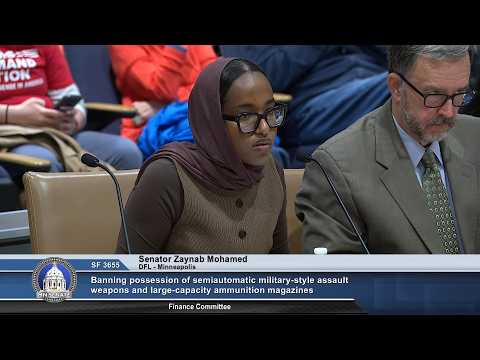
Sen. Mohammed’s gun‑violence package advanced by Senate Finance Committee; members press for consolidated fiscal note
Summary
The Senate Finance Committee adopted an A19 amendment packaging multiple gun‑violence measures — including a semiautomatic assault‑weapons provision, ghost‑gun restrictions, expanded extreme‑risk protections, and school‑safety and mental‑health funding — and laid SF3655 over for final action tomorrow while senators demanded a single fiscal note tied to the amendment.
St. Paul — The Senate Finance Committee on April 27 advanced a broad gun‑violence prevention package, approving an A19 “delete‑everything” amendment that bundles proposals ranging from an assault‑weapons restriction and limits on high‑capacity magazines to new school‑safety aid and mental‑health grants, and laid Senate File 3655 over until lawmakers resume work tomorrow.
Senator Mohammed, the author, framed the package as a response to the Aug. 27, 2025, shooting at Annunciation Church in South Minneapolis and said the legislation combines many months of bipartisan work. “When it comes to keeping kids safe, the only responsible choice is all of the above,” Senator Mohammed said, describing the measure as a mix of school‑safety investments, expanded extreme‑risk protection orders, a re‑ban of binary triggers and a prohibition on certain semiautomatic military‑style weapons and high‑capacity magazines.
The amendment includes appropriations and policy changes detailed by committee staff. Budget analyst Lisonbee Turner walked members through a unified spreadsheet that enumerated correctional‑bed costs for the Department of Corrections, a $952,000 estimated system cost tied to a certificate‑of‑ownership tracking system for the Bureau of Criminal Apprehension (of which $450,000 was shown as contracting costs), a $100,000 public‑awareness campaign, a $500,000 violence‑prevention research grant, and multiple one‑time grants including school‑linked behavioral health grants ($2.7 million) and a $19 million school‑safety aid appropriation.
Mr. Bacchus provided a section‑by‑section policy overview: Article 2 would require owners of specified semiautomatic military‑style weapons to certify ownership with the Bureau of Criminal Apprehension and would prohibit federally licensed dealers from facilitating sales of those weapons; Article 3 would expand school‑property definitions, strengthen negligent‑storage and ghost‑gun prohibitions (including criminalizing the sale or transfer of files and instructions used to manufacture ghost guns), and expand who may petition for extreme‑risk protection orders; Article 4 would raise certain medical‑assistance reimbursement rates; Article 5 contains conforming changes.
Committee members pressed repeatedly for a single, consolidated fiscal analysis tied specifically to the A19 amendment rather than relying solely on the staff spreadsheet. “This bill is significant enough that we should not be shortcutting the process,” Senator Pratt said, urging the Legislature’s budget staff to prepare a comprehensive fiscal note that explains assumptions and interactions across sections. Senator Draheim and others asked for clarity on sales‑tax implications and whether costs the Attorney General’s office might incur to defend enforcement were reflected.
Staff and the bill’s authors responded that many of the individual bills carried in the package already had fiscal notes and that the spreadsheet was intended to unify those figures; staff agreed to provide updated fiscal materials and to pull underlying fiscal notes for committee review tomorrow. Assistant Attorney General Eric Maloney told the committee that, to his knowledge, the only provision with a separate Attorney General fiscal note was the ghost‑gun measure (listed as a ghost‑gun bill), and that the AG’s office expected to absorb enforcement costs reflected in its fiscal note.
Members also clarified timing and implementation mechanics. Staff said the effective date for several assault‑weapons provisions in the delete‑everything amendment was moved to July 1, 2027 (from an earlier date that had appeared in prior drafts), which would shift associated appropriations and implementation timelines.
The committee approved a set of page‑5 edits that, among other technical fixes, made a $37,000 anonymous reporting appropriation ongoing rather than one‑time. After debate, the committee adopted the A19 amendment as amended and laid SF3655 over; the chair said the A19 language will be offered as a delete‑everything amendment to Senate File 4067 when the committee reconvenes at 8:30 a.m. tomorrow for a final vote.
What’s next: The Finance Committee will resume at 8:30 a.m. to take up SF4067 as the vehicle for the package; staff said they will provide updated fiscal materials and the underlying fiscal notes for items included in the A19 amendment.