Get AI Briefings, Transcripts & Alerts on Local & National Government Meetings — Forever.
Simsbury zoning panel approves site-plan revisions for Cambridge Crossing (now Copper Hill Estates), 5–1
Summary
The Zoning Commission approved amendments to the Cambridge Crossing/Copper Hill Estates site plan to convert front duplexes to single-family homes, update the affordable-housing phasing to prioritize four early units, reduce a heavy planting buffer in favor of fencing plus 50 arborvitae, and remove an off-site sidewalk requirement. The motion passed 5–1.
The Simsbury Zoning Commission on Monday approved a site-plan amendment for the Cambridge Crossing development (now called Copper Hill Estates), allowing the developer to convert several front duplexes to single-family homes, revise landscaping and phasing, and alter affordable‑housing commitments. The motion approving application ZC26‑09 passed 5–1.
Planning staff framed the application as a response to a change in ownership and a need to complete unfinished infrastructure left by the project’s previous developer. Staff said the development originally approved in 2015 includes about 79 homes, with roughly 33 currently occupied, six permitted or under construction, and about 40 units still unbuilt. The new owner, the commission was told, acquired the property through foreclosure and proposed updated phasing and a commitment to accelerate affordable units.
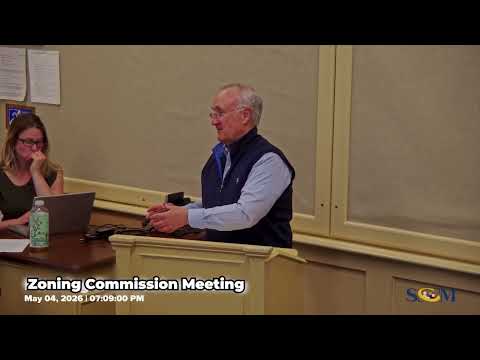
“I represent the owners of the property,” attorney Alan Kerner told the commission, describing the team’s work to stabilize erosion, flush out sediment, and produce a phasing plan. “The next four building permits are gonna be for workforce housing,” Kerner said, adding that the developer expects that sequence will put the project “actually 1 unit ahead.”
Much of the public discussion focused on how the development’s affordable units will be controlled and whether deed‑restricted units must remain for‑sale. Staff said 16 affordable units are required for the site; four have been built and one is under construction, leaving roughly 11 still to be delivered. Staff and the applicant explained that the affordability restriction is tied to the physical unit and typically survives turnover, but owners who meet income thresholds may remain or, absent a local prohibition, rent their unit.
Commissioners disagreed over whether to impose a local bar on rentals. Commissioner Jackie (opposed vote) said she favored preserving for‑sale housing stock, arguing Simsbury needs homes for sale. Other commissioners supported allowing limited rental or rent‑to‑own arrangements as a practical way to help households bridge to homeownership. The commission did not add a rental prohibition; staff advised that, unless the commission adopts specific restrictions, the plan as approved would permit owners to rent within the constraints of the affordability rules.
The commission also considered a longstanding condition that would have required the developer to build an off‑site sidewalk to Hot Meadow Street. The applicant’s attorney cited Connecticut case law that a zoning commission cannot impose off‑site improvements as a condition of zoning approval and said the town’s remedy is a sidewalk assessment. Staff agreed the off‑site condition likely conflicts with state law and recommended removing it as part of the amendment.
Landscaping and buffering between the new houses and nearby apartments drew detailed scrutiny. The original plan included an extensive planting schedule that staff called “over planted” and costly for an HOA to maintain. The developer proposed substituting a six‑foot vinyl fence and far fewer plantings; commissioners pressed for some low‑maintenance vegetation to break up the visual effect of a fence. The applicant agreed to install 50 arborvitae along the perimeter as a compromise.
Staff described a pro‑rata phasing and certificate‑of‑occupancy approach to ensure affordable units are built as market units are released. George, the planning staff member, said the town will monitor permit issuance and can withhold later permits or certificates of occupancy if the developer does not meet the agreed sequencing.
After discussing eight conditions presented on the screen — including substantial conformance to the submitted phasing, an updated affordable‑housing plan, revised Phase 1 landscaping, and architectural elevations — the commission amended the motion to add the 50 arborvitae in the buffer area and to memorialize that the next four residential building permits will be for affordable units. A member moved the motion to approve ZC26‑09 with those conditions; the motion was seconded and passed 5–1.
The commission’s approval does not impose a townwide ban on renting deed‑restricted units; commissioners noted deed restrictions and state rules limit how affordability is administered but do not automatically prevent an owner from renting under some circumstances. The commission’s conditions focus on phasing, infrastructure and a revised landscaping plan subject to the town planner’s final approval.
Planning director George announced a special joint working meeting on the zoning update with the Planning Commission for May 26 at 7 p.m. The commission then voted to enter executive session to discuss pending litigation.
The applicant team thanked the commission before the meeting moved into executive session; the developer’s representatives said they planned to begin work promptly once permits are issued and that the amended phasing would help complete long‑delayed infrastructure.
What happens next: the approval is memorialized with eight conditions and the town will monitor permitting and CO issuance to ensure the affordable‑housing sequencing is met. The planning office will finalize any landscape adjustments in consultation with the applicant and the town planner.