Get AI Briefings, Transcripts & Alerts on Local & National Government Meetings — Forever.
How Vermont's pavement program prioritizes work: PCI scores, lifecycle math and limited budgets
Summary
Agency of Transportation chief Jeremy Reed explained the PCI scoring system, lifecycle-based decision model and ballpark per-mile costs for preservation, reclaim and reconstruction; he said the agency uses an iterative pavement-management model to maximize network condition given constrained funds.
Jeremy Reed, chief engineer at the Agency of Transportation, briefed the House Transportation committee on May 5 about how the state assesses pavement condition and decides which road sections get preservation, rehabilitation or reconstruction treatments.
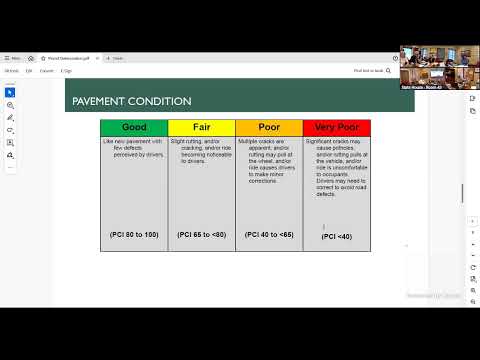
Reed described the PCI (pavement condition index), a 0'to'100 composite score the agency assigns to segments (the state uses finer-grade bands than federal categories). He said staff collect structural and environmental data on fixed-length segments (about 0.05-mile/10-foot-mile units used in the model) and then run an iterative budget simulation to pick treatments that optimize network performance.
On costs, Reed gave order-of-magnitude per-mile figures: a preservation treatment (surface restoration) typically runs in the mid hundreds of thousands of dollars per mile (roughly $300,000'$500,000), more substantial overlays or restores $500,000'$750,000 per mile, major reclaim work about $1,000,000+ per mile and full reconstruction potentially around $2,000,000 per mile. He framed preservation as a life-cycle strategy: targeted, lower-cost treatments every 8'12 years can delay large, expensive reconstructions.
The agency's pavement management system, Reed said, runs tens of thousands of iterations with input parameters for preservation, rehabilitation and reclamation budgets and aims to keep travel-weighted average PCI near agency targets and very-poor roadway share below a threshold. He emphasized the model is fluid: losing an earlier treatment opportunity can change what is viable later and raise future costs.
On resilience and grants, Reed pointed to the Better Roads program as a funding path municipalities use to improve crown, ditching and rock-lined ditches to reduce flood damage; he cautioned that surface paving alone is not a silver-bullet for flood resilience when subbase and watershed conditions drive failures.
Reed also described limited but growing use of drones for wide-area flood surveys, volumetrics in new construction and bridge inspections where rope access is costly. He said agency use is deliberate and targeted to where cost and safety benefits justify it.
The committee asked for clearer FAQ materials and data transparency; members signaled interest in how budget scenarios change the recommended project list. No votes or formal actions were taken during the session.