Get Full Government Meeting Transcripts, Videos, & Alerts Forever!
Get email alerts on the Groundwater Nitrate Lower Umatilla topic
No spam. Unsubscribe anytime.
State, local and federal officials outline multi‑agency plan to tackle nitrates in Lower Umatilla Basin
Summary
At an informational hearing May 13, 2025, Oregon agencies, county officials, the EPA and community groups described coordinated steps — from drinking‑water support to permit changes, rulemaking and potential aquifer restoration — to address long‑running nitrate contamination in the Lower Umatilla Basin groundwater management area.
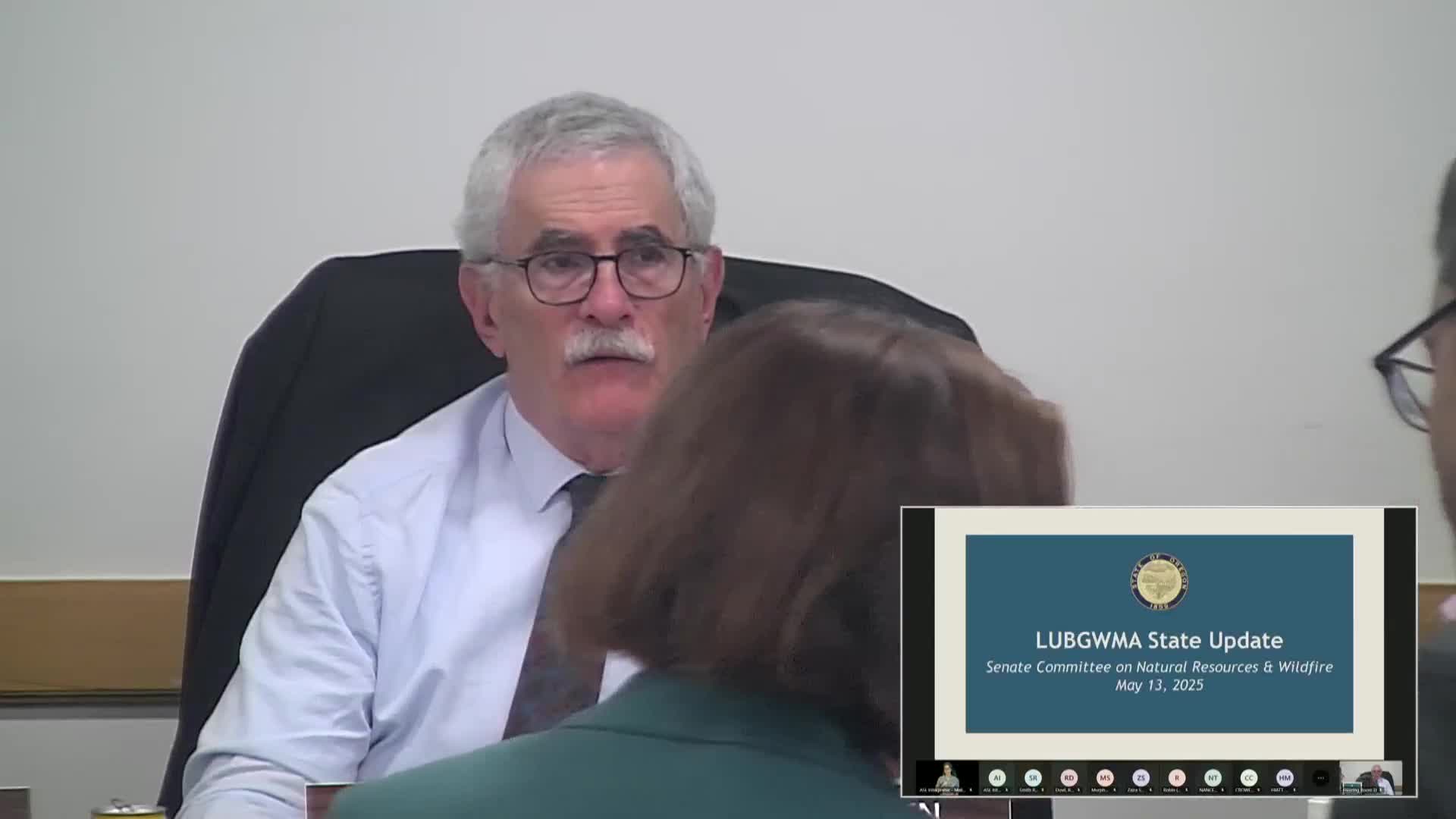
State agencies, local leaders and community groups told the Senate Committee on Natural Resources and Wildfire on May 13 that addressing decades of nitrate contamination in the Lower Umatilla Basin will require sustained funding, continued community outreach and a mix of short‑, medium‑ and long‑term actions.
At an informational hearing chaired by Chair Golden, speakers described current work under the state’s recently published Nitrate Reduction Plan for the Lower Umatilla Basin (the groundwater management area sometimes referenced in testimony as “LUBGAMA”), and outlined additional steps: expanded household testing and immediate safe‑water services; updated wastewater and confined animal feeding operation permits; rulemaking aimed at agricultural nutrient management; well construction inspections; targeted municipal connections for contaminated domestic wells; and investigation of aquifer restoration techniques.
Why it matters: thousands of households in Morrow and Umatilla counties rely on unregulated domestic wells for drinking water. At or above the U.S. Environmental Protection Agency’s maximum contaminant level of 10 milligrams per liter (mg/L) for nitrate, water is considered unsafe for infants and pregnant people and a potential long‑term risk for other health outcomes. Officials said nitrate concentrations in parts of the basin have risen over recent decades and that reversing those trends will take years and substantial funding.
The Oregon Health Authority has been providing direct services since 2023 under a governor’s directive. "The important number to remember is 10 milligrams per liter of nitrate per liter of water," said Gabriela Goldfarb, environmental public health section manager at the Oregon Health Authority, who serves as the La Guama public‑health project manager. Goldfarb described a program of free household testing, short‑term water delivery for affected households and installations of point‑of‑use kitchen treatment systems where effective. She said those services will continue "until residents have access to more durable sources of safe drinking water."
State environmental regulators described regulatory and technical work underway. Laura Gleim, DEQ’s regional solutions representative for Eastern Oregon, said DEQ has reviewed and updated wastewater permits in the area and added monitoring, seasonal limits on land application and storage or treatment requirements where necessary. "There are no simple or quick solutions to this issue," Gleim said. "It will take continued effort and resources over decades to see a significant reduction in nitrate in this area."
The Oregon Department of Agriculture is pursuing rulemaking and targeted outreach. Isaac Stapleton, ODA’s Natural Resources Division director, said a rules advisory committee convened in March to advise draft rules focused on fertilizer and nutrient practices; the draft language is posted on the state rulemaking webpage and the agency expects public comment later in 2025. ODA is also piloting Strategic Implementation Areas (SIAs), a targeted outreach and compliance approach adapted from surface‑water programs to identify fields and parcels where additional technical assistance or compliance work is warranted.
The Oregon Water Resources Department said it will emphasize well construction inspection and data collection. "We have committed to inspect at least 90% of new wells drilled within the groundwater management area," said Chris Coits, North Central region manager for OWRD. Water Resources reported an updated conceptual hydrogeology report that has completed internal peer review and will be externally reviewed before publication. Coits said the agency is also pursuing public data platforms to share monitoring results broadly.
Local governments and industry described parallel efforts. Morrow and Umatilla counties and the Port of Morrow have formed a Clean Water Consortium to identify and finance public water extensions for unincorporated communities relying on contaminated wells. Joe Taylor, a Port of Morrow commissioner, said the consortium’s first legislative funding request is about $2.8 million to construct a public water system for the West Lehi community near Boardman. "The port and the county are combining technical, administrative and financial resources to advance projects that directly serve residents relying on unregulated domestic wells," Taylor said.
Community groups and residents said outreach and meaningful participation must improve. "The barriers to participate in meetings must be removed in order for our community to be able to meaningfully participate," said Bridal Sanchez, director of community organizing at Oregon Rural Action, describing language, scheduling and trust barriers in past agency engagement. Oregon Rural Action and other advocates urged more door‑to‑door testing and culturally‑appropriate outreach to households that have not yet been reached.
Speakers representing local environmental groups, farmers and a regional water‑industry coalition emphasized the need for both immediate drinking‑water solutions and long‑term source control. Justin Green, executive director of Water for Eastern Oregon, described a three‑pronged strategy: drinking‑water response, reducing current nitrate loading, and addressing legacy nitrate already in groundwater — including pilot aquifer restoration projects. "We need to measure progress," Green said, urging more hydrogeologic study and monitoring so agencies can test whether actions lower nitrate concentrations.
Federal officials said the EPA will continue technical support. Greg Duvel, EPA Region 10 technical adviser, praised the state plan and implementation and said the agency will monitor progress and coordinate on technical approaches. "If there’s an opportunity for EPA to support the state, it will happen," he said, while noting that decisions about direct funding would come from other EPA program units.
Legislative and budget questions remain. Jeff Huntington, senior policy advisor for natural resources in the governor’s office, said the governor’s staff is "scrubbing" Senate Bill 1154 (a bill discussed at the hearing) to ensure it does not interfere with work in the Lower Umatilla Basin and to clarify agencies’ authorities for a more proactive, place‑based response in the future. Huntington said the governor’s recommended budget represents a more integrated, cross‑agency approach than past budgets but acknowledged that implementation will require additional place‑based funding commitments going forward.
Committee members and presenters repeatedly identified funding and data gaps as the most immediate obstacles. County and local officials said monitoring networks have been underfunded for decades: commissioners and planners said the basin historically lacked sustained agency capacity and long‑term monitoring funds. "We have to have consistent, usable data before money means anything," Umatilla County Commissioner Dan Dorn said.
The hearing closed with broad agreement on the scale of the challenge: multiple agencies, tribal and federal partners, local governments, industry and community organizations will need to sustain coordinated work for years. Chair Golden closed the session by thanking the participants and noting the committee will follow implementation in coming months.
Ending: Agencies, county leaders and community groups left the committee with a list of near‑term priorities — sustained outreach and drinking‑water services, targeted municipal connections, continued permit updates and rulemaking — and a request for sustained funding and improved data sharing to evaluate whether the proposed actions reduce nitrate concentrations over time.