Get Full Government Meeting Transcripts, Videos, & Alerts Forever!
Get email alerts on the Developmental Disabilities topic
No spam. Unsubscribe anytime.
Senate approves bill tightening oversight, funding rules for Parents as Paid Caregivers program
Summary
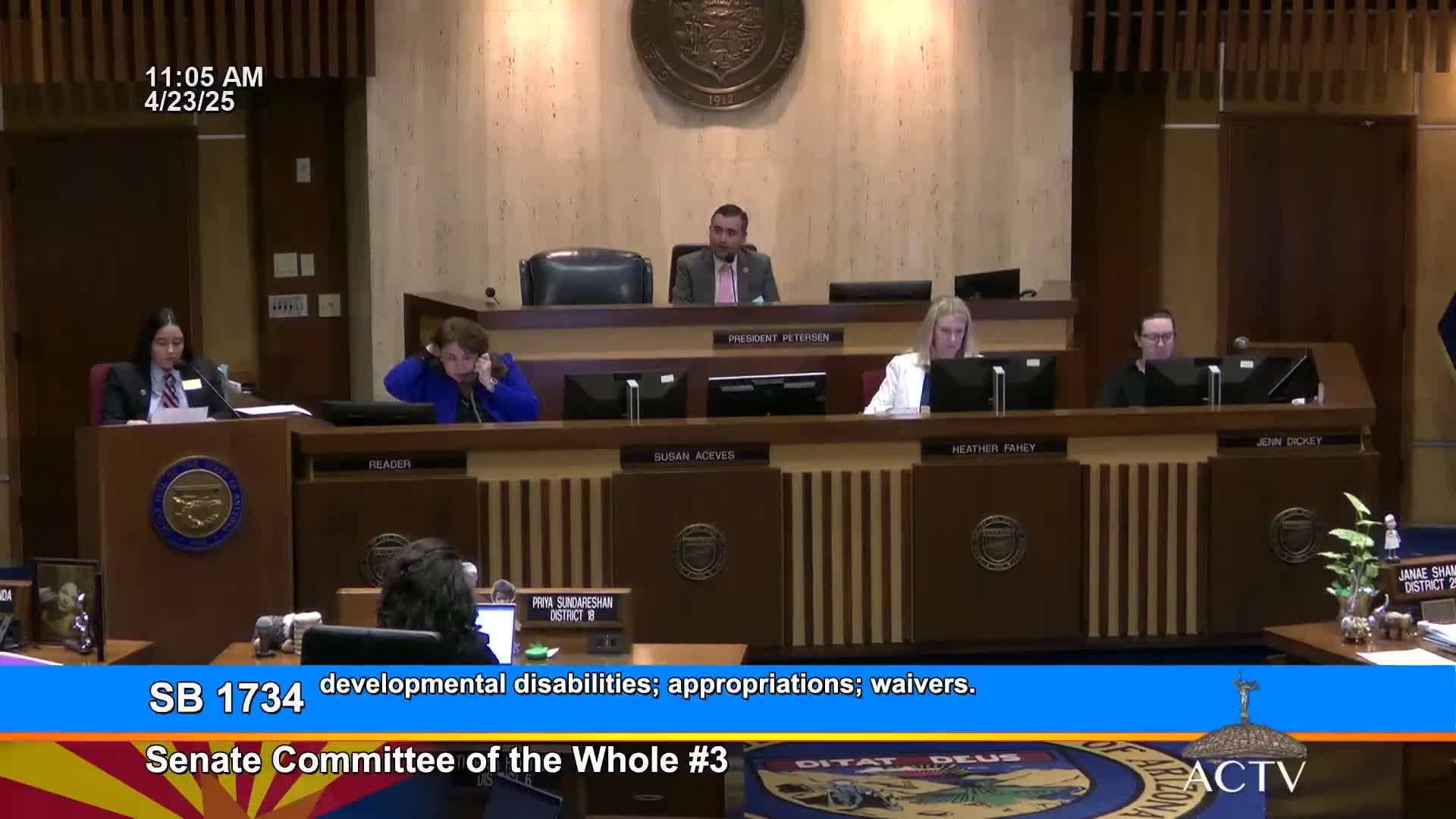
PHOENIX — The Arizona Senate on Wednesday passed Senate Bill 1734, a package of changes to developmental-disability services that includes new billing rules for the Parents as Paid Caregivers (PPCG) program, quarterly reporting requirements and new limits on when and how federal Medicaid waiver changes may be submitted.
PHOENIX — The Arizona Senate on Wednesday passed Senate Bill 1734, a package of changes to developmental-disability services that includes new billing rules for the Parents as Paid Caregivers (PPCG) program, quarterly reporting requirements and new limits on when and how federal Medicaid waiver changes may be submitted. The Senate approved the measure as amended on a 16-13 vote, with one member not voting, and instructed the secretary to transmit the bill to the House.
The bill, carried on the floor by Senator John Kavanaugh, the Appropriations Committee chair, was amended on the Senate floor with a committee amendment and a Kavanaugh floor substitute that sponsors said reflected stakeholder meetings with service providers and family members. Supporters said the changes add guardrails and increase program transparency; opponents said the measure contains “poison pills” that could put the program and the families who rely on it at risk.
Provisions adopted as part of the amendment package remove the requirement that capitation rate adjustments be specified in the General Appropriations Act and instead leave certain actuarial decisions to technical staff. The Department of Economic Security (DES) must implement an electronic visitor verification system and separate billing modifiers to distinguish parent providers from nonparent providers and to separate attendant care from habilitation services. The amendment also prohibits parents from billing for attendant-care services when the minor child is not present — including when the child is at school or receiving inpatient or clinical care — and bars billing for routine household tasks ordinarily performed by a parent.
The amendment requires DES to provide the Joint Legislative Budget Committee (JLBC) a quarterly report on PPCG usage that must include: growth in enrolled parents and members, quarterly emergency department visits and hospitalizations, approved annual hours by primary diagnosis and length of enrollment in PPCG. The bill also directs DES and “Access” to adopt a strengthened standardized assessment tool to identify the need for extraordinary care for minor children and to separate household tasks that would ordinarily be performed by a parent without a disability.
On waivers, the amendment places new limits on when Access may submit Section 1115 demonstration-waiver amendments to the Centers for Medicare & Medicaid Services (CMS). It bars Access from submitting any amendment that would (a) expand eligibility to populations not authorized as of Jan. 1, 2025, (b) add services not authorized as of Jan. 1, 2025, or (c) lead to an annual utilization increase greater than 10% for the services affected — unless the change has been authorized in statute. The amendment requires a three-year utilization monitoring period after implementation and requires Access to notify JLBC and legislative leaders if utilization increases more than 10%; if the Legislature does not authorize the change within one year, Access must request CMS to terminate the unauthorized waiver change.
Funding sources for the bill were a repeated point of contention on the floor. Senator Kavanaugh said the package would draw $38 million from the Arizona Housing Trust Fund and that prescription-rebate and other funds were also being considered. Opponents said using the housing fund risks projects already awarded money and pits vulnerable populations against one another. “Taking money from the housing trust fund is just mean and unnecessary,” said a senator who explained a no vote during the roll call.
Floor debate featured repeated cautions about timing and stakeholder engagement. Senator Epstein said she was “alarmed at this coming to us in Committee of the Whole with no time to read it,” and urged more conversations with agency staff and families before final action. Senator Kavanaugh said the changes reflect stakeholder input and that the expedited timetable was driven by a need to avoid service disruption; he added the governor’s office had been in communication with bill staff and that the matter would continue in negotiations as the House considers the measure.
Votes at a glance: Senate Bill 1734 (as amended) — Passed 16–13 (1 not voting). Key recorded explanations on the floor included Senators Kavanaugh and Farnsworth saying they voted yes and multiple senators including Epstein, Ortiz, Olson, Gonzalez, Sears and others explaining no votes.
The bill will next go to the Arizona House, where sponsors and opponents signaled further negotiation is likely. The Senate record shows the measure was passed without the emergency clause; sponsors and opponents on the floor urged further review, stakeholder outreach and post-enactment monitoring steps if the House and governor approve the measure.