Get Full Government Meeting Transcripts, Videos, & Alerts Forever!
Get email alerts on the Jobs Omnibus Sf1832 topic
No spam. Unsubscribe anytime.
Senate jobs omnibus (SF1832) advances as committee adopts DE amendments; markup set for April 9
Summary
The Minnesota Senate Committee on Jobs and Economic Development voted to adopt the DE amendments to Senate File 18 32, the jobs omnibus bill, and heard a staff-led walkthrough of budget and policy changes on April 7.
The Minnesota Senate Committee on Jobs and Economic Development voted to adopt the DE amendments to Senate File 18 32, the jobs omnibus bill, and heard a section-by-section walkthrough and fiscal spreadsheet during its April 7 hearing.
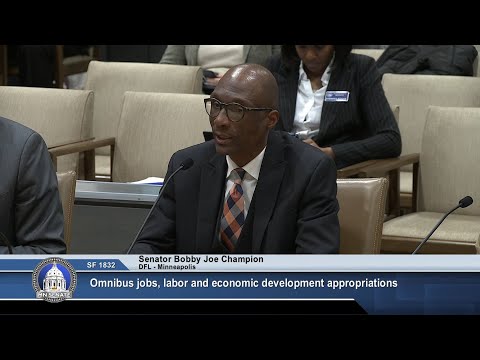
Senator Omar Champion, presenting the bill as amended, said the package is “primarily a budget document” but highlighted policy changes including new reporting language for direct appropriations, labor-participation reporting by county and modifications to the Promise Act. Senator Champion said staff and members requested that previously proposed sunset language for certain reports not be included.
The bill’s counsel and fiscal staff then reviewed the draft. Senate counsel (Miss Fontaine) told the committee that Article 1 includes the reporting requirements, combining elements from Senator Pratt’s bill and reporting language originally from the 2016 equity article. Counsel walked the committee through Articles 2–6, flagging a community violence prevention appropriation, exemption language for a ProStart program, clarifying statutory terminology for Enterprise Minnesota and changes to the DEED cannabis start-up loan program (increasing loan amounts and adjusting approval timelines).
Senate fiscal staff (Miss Noldner) summarized the “change‑only” spreadsheet. The packet shows a net general‑fund reduction of $14,000,000 in fiscal 2024‑25, a net decrease of $8,600,000 in fiscal 2026‑27 and a $4,500,000 increase in the tails (fiscal 2028‑29). Fiscal staff also described numerous one‑time appropriations and transfers, including an increase of one‑time Promise Act funding ($4,500,000) split across five regions and separate one‑time grants to nonprofit and local programs. The spreadsheet also lists one‑time tourism allocations (a $1,500,000 appropriation for the 2026 Special Olympics U.S. Games and $5,000,000 for the World Junior Hockey Championships) and several smaller awards to community organizations and workforce providers as detailed in the committee packet.
Policy details highlighted in the walkthrough include Promise Act changes that clarify eligible projects and expand loan terms and sizes: the bill increases the maximum Promise Act loan from $1,000,000 to $1,500,000 and extends the loan term from 10 to 20 years, and adds limits on uses of repaid Promise loans to exclude speculative investments in rental real estate. Counsel said those changes would take effect the day following final enactment.
Miss Fontaine also described modifications to DEED’s cannabis start‑up loan program: the bill raises loan amounts for microbusiness loans and adds statutory timing requirements for DEED’s final approval decisions. Senator Graham raised concerns about the possibility that a broadened definition of “agricultural processing” might allow projects related to hemp or cannabis; Devin Boudreaux (government relations director) said such projects “could” be eligible but are not excluded. DEED Commissioner Matt Verlick told the committee the intent of expanding “plant‑based processing” language is to allow a broader set of good projects (corn, soybeans, cannabis, etc.) and stressed that funds are delivered to local units of government, which would not request funding for a project they opposed.
The hearing included two testifiers. Xin Yi Chien, director and statewide specialist at the Tourism Center, University of Minnesota Extension, urged committee members to modify a residency‑verification requirement that the center said deterred participant enrollment. Chien said the online, mobile‑friendly program requires collection of personally identifiable information, including Social Security numbers, and the verification requirement was “deterring a potential participants from taking the program.” She asked the committee to consider changing the reporting or verification requirement to avoid reducing enrollment.
Senator Graham asked Senator Champion whether Champion had any legal contracts with organizations named in the bill after recent news reports alleging conflicts. Senator Champion denied representing any organization included in the bill, saying he had “no legal contracts with any of the named organizations in this bill” and confirmed any prior agreement referenced in reporting ended in October 2022; he said he requested an advisory opinion from the ethics committee to be transparent.
Before adjourning, the committee approved the motion to adopt the DE amendments by voice vote. The chair set formal markup for April 9, with the committee to convene at 12:30 p.m. and recess from 1:00–1:45 p.m., then continue as needed.
What’s next: committee staff encouraged members to submit amendment requests by Wednesday; the package as presented contains a mix of ongoing adjustments and many one‑time appropriations and transfers that members said will remain subject to negotiation during the markup.