Get Full Government Meeting Transcripts, Videos, & Alerts Forever!
Get email alerts on the North Star Promise topic
No spam. Unsubscribe anytime.
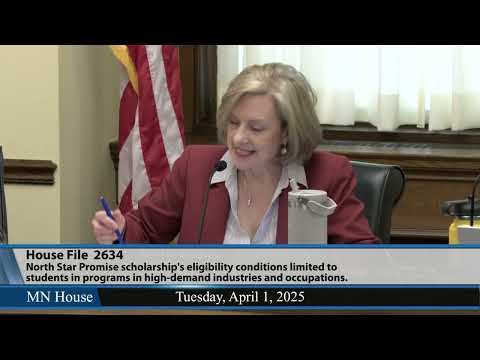
Committee hears debate over narrowing North Star Promise to top 20 high‑demand fields
Summary
Lawmakers, business groups and students debated House File 2634, which would limit North Star Promise eligibility to programs aligned with DEED/OHE'identified high‑demand industries and require periodic review of the list. Supporters cited workforce needs; opponents said the change would restrict access and add complexity.
House Higher Education Finance and Policy Committee members heard more than an hour of testimony and questioning on House File 2,634, a bill that would narrow eligibility for the North Star Promise scholarship to students pursuing programs in the top 20 industries and occupations identified by the Minnesota Department of Employment and Economic Development (DEED) and the Minnesota Office of Higher Education (OHE).
Proponents, including local chamber leaders and the Minnesota Chamber Federation, said the proposal would better align state tuition investments with workforce needs and retain graduates in Minnesota. Brad Grama, president of the Marshall Area Chamber of Commerce, told the committee that border communities face talent loss to neighboring states and argued the policy would help keep Minnesota employers supplied with trained workers. Christie Ransom, president and CEO of the Winona Area Chamber of Commerce, said Winona has 499 open jobs and called the proposal a data‑driven way to channel public dollars into programs that lead to local employment.
Opponents — including student leaders, higher‑education advocates and North Star Promise supporters — warned the bill would complicate the program and reduce enrollment gains the scholarship has produced. Mike Dean, executive director of Northstar Prosperity, said the North Star Promise'''s simple "free college" message has driven enrollment increases and argued restricting majors would reverse those gains. Student testifiers described the scholarship as transformative: Jessica Rose Sander, a University of Minnesota freshman, said HF 2,634 would "narrow our choices and force students into specific high demand fields without giving them the guidance or flexibility we need." Shay Horning, an undergraduate student government leader, urged rejection of HF 2,634 and related proposals that add residency or work requirements.
Committee members questioned practical and technical issues raised by OHE staff. Wendy Robinson, assistant commissioner at OHE, told the panel that producing a fiscal note is difficult because the exact "top 20" list is not defined in the bill and program audit data on students' declared majors and program changes are incomplete. Robinson said many career pathways map to multiple degree programs (for example, registered nursing can include BSN, RN and LPN pathways) and some high‑demand jobs do not require college degrees, complicating eligibility rules and cost projections.
Several legislators pressed on enforcement and operational details. Representative Hansen and Representative Hicks asked how OHE would track students who change majors, how often eligibility would be rechecked, and whether institutions or OHE would need additional staff to monitor enrollments. Representative Birkbeck, the bill author, said she would be open to technical amendments such as requiring industry certifications for some pathways and emphasized the measure's goal of matching taxpayer dollars to jobs.
The committee did not take a final vote on the bill but laid HF 2,634 over for possible inclusion in the omnibus package.
Ending: Committee members signaled continued interest in workforce alignment but also concern about administrative complexity and impacts on students. OHE staff said additional work is needed to define the eligible list, estimate costs and design feasible reporting; members left the provision open for amendment and further negotiation.